
1885 - 1916
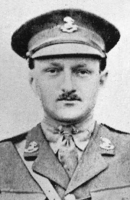
CPL David Wallace Crawford
1887 - 1916
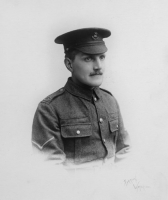
Lce-Corpl John Joseph Nickle
1894 - 1916
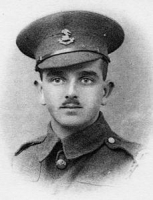
Pte 17911 Morton Neill
1897 - 1916
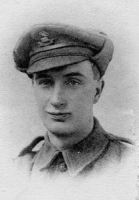
Lieut Edward Stanley Ashcroft
1883 - 1918
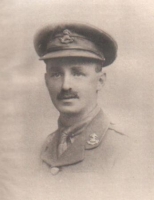
L/Sgt 15716 Edward Proctor (DCM)
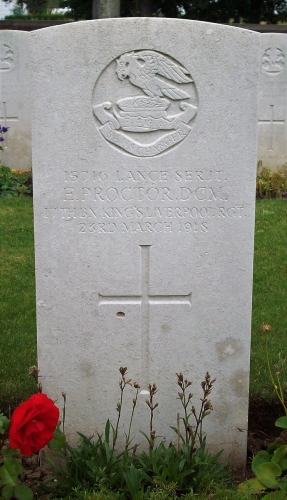
- Age: 34
- From: Dalton in Furness
- Regiment: The King's (Liverpool Regiment) 17th Btn
- D.O.W Saturday 23rd March 1918
- Commemorated at: Ham British Cem
Panel Ref: II.C.3
Edward was born in Dalton in Furness the son of John Proctor and his wife Jane (Jennie, nee Fell) who married in Kendal in 1881. Edward was baptised on the 17th February 1884. His father John was born in Westmoreland, his mother was born near Ulverston. Edward was the second child and eldest son, his siblings were Margaret Agnes, Mary, John, and Isabell.
The 1891 Census shows the family are living at The Malt Shovel, Milnthorpe, Westmorland. His father is a beerhouse keeper. Edward is 7.
The 1901 Census shows that the family are still living at the Malt Shovel Inn, Milnthorpe. His father is an innkeeper (own account). Edward is now 17 and is shown as a gardener’s labourer.
In 1911, his parents and sister Isabell are at Old Malt Shovel in Milnthorpe. His father is now a farm bailiff. (The only Edward Proctor found born in Dalton in Furness is an attendant in St. Cuthbert’s asylum in Cumberland).
Edward enlisted at St George's Hall in Liverpool on 02nd September 1914 joining the 17th Battalion as Private 15716. He states that he is 30 years and 240 days old and has been living in Liverpool for three years. He is described as being 6’ 2 and a half inches, 153 lbs, fresh complexion, with blue eyes and dark hair. He had previously served in the 2nd Border Volunteers, 4 years, time expired.
He was billeted at Prescot Watch Factory from 14th September 1914, he trained there and also at Knowsley Hall. On 30th April 1915 the 17th Battalion alongside the other three Pals battalions left Liverpool via Prescot Station for further training at Belton Park, Grantham. They remained here until September 1915 when they reached Larkhill Camp on Salisbury Plain.
He arrived in France on 7th November 1915. His service record has survived and tells quite a story.
On 26th February 1916 Edward is treated by the Field Ambulance with burns on the right leg. He is subsequently transferred on 03rd March 1916 to 21 Casualty Clearing Station with Inflammation to the Connective Tissue (I.C.T.) in his right leg. On 14th March 1916 admitted to 2 G.H.
Edward is then wounded on 02nd July 1916 and is admitted to 23 Field Ambulance on 05th July with a gun shot wound to the face. He was admitted to hospital on 08th July 1916 with the gun shot wound now described as being to the right side of his nose and cheek. He was sent home to the UK and upon arrival on 08th July he was admitted to King George Hospital, Stamford Street, South East London. This hospital was reputedly the largest hospital in the U.K. Wounded men were brought by boat train to Waterloo Station nearby. Tunnels connected the building to the station so as to facilitate movement of supplies, and these enabled badly wounded men to be conveyed to the hospital out of sight of the public. He spent 38 days in hospital.
In the 04th August 1916 edition the Liverpool Daily Post, reported that Edward had been wounded.
Edward was recuperating from wounds in England from 08th July 1916 until 11th January 1917
He returned to 17th Bn on 13th January 1917. He was appointed unpaid Lance Corporal 16th April 1917 then he was appointed paid Lance Corporal 18th May 1917. Further Promotion followed when he was appointed paid Lance Sergeant 10th August 1917.
From the 11th to 25th January 1918, he was home on leave to U.K.
Edward was awarded the Distinguished Conduct Medal. The award was reported in the Lancashire Evening Post on 20th April 1918
“For conspicuous gallantry and devotion to duty. Except for a period of six months, when he was recovering from wounds, he has been with the battalion in every engagement since early in the campaign, and by his total disregard of danger, fine work and splendid example, he has gained the confidence and respect of officers and men. On one occasion he dug out, under heavy shell and rifle fire, two of his comrades, who had been buried, undoubtedly saving their lives.”
He was serving in ‘C’ Company, 11th Platoon of the 17th Battalion of The King's Liverpool Regiment when he was reported as Missing on 23rd March 1918. His death is recorded in SGDW as being died of wounds. Those wounds were undoubtedly received on the 23rd March as is shown by the recollection of Private J Sykes of the 17th Bn who reported:
“I knew Proctor personally. I and several others saw him killed. It was on the St. Quentin front in the morning. He was hit by a bullet in the stomach. He did not die at once. We had to retire and leave him. He said “Leave me I’m done for.” Sgt. Russell took his Military Medal off and all his papers and sent them to his mother. I think he lived in Cumberland.”
Description for identification: One nostril was gone (July 1916), about 6’6” thin, dark, the tallest man in the Regt.
The Battalion diary gives further details of the events of the day:
23rd March
Battalion HQ established in position near North Bridge. Battalion in defensive positions N. of HAM
At 6.30 am our troops began to retire through the town and gave information that the enemy had broken through on their flanks and at 7am the bridge north of HAM was blown up. Slow retirement made through the town, the enemy having apparently entered from the South Eastern end and being well inside the town. At 7.30am the South Bridge was also blown up. Morning very misty and difficult to distinguish our troops from the enemy.
8.30am In conjunction with the 18th Bn KLR position established N.E. of VERLAINES. During the morning our troops advanced and established a position on the crest of hill S.W. of HAM in spite of heavy machine gun fire. Two enemy M.G.’s captured and enemy aeroplane which had been flying low over our positions was brought down by rifle fire. Hostile machine guns and enemy aeroplanes very active, also enemy artillery in and S. of VERLAINES.
Battn H.Q. in sunken road abt 200 yards N.E.of VERLAINES. About 12 noon details of 61st Division passed through our position occupied by Bn. H.Q. under orders to capture VERLAINES. They went forward to positions occupied by our troops and dug in on the left of our position. Their positions were reconnoitred and found to be very unsatisfactory, and it was arranged that he should thin out and deploy his troops more to the left, ours being extended to keep joined up with him.
Edward was found dead on 09th April 1918 from a gun shot wound to the chest. Buried by the Omery-Hallam Road by the Germans who took the trouble to bury Edward alongside another man. They also named both men on a German Cross. They placed the following inscription on the headstone
“Hier ruhen in Gott Barclay & Proctor zwei Englander (Here rest in God, Barclay & Proctor two Englishmen)
The second man buried alongside Edward was Thomas Stanley Barclay, Private 21097 of the South Lancashire Regiment.
Enquires were made to the International Red Cross in order to establish whether Edward had been captured and was a Prisoner of War:
Mr. A. McKinnel at 77 Olney Street, County Road, Walton, Liverpool, having been formed that Edward had been wounded on 24th March, made enquiries with the International Red Cross, but was notified on 01st June 1918 that they held no information. (This is possibly Cpl. 26543 Arthur McKinnell, 17th Bn., suffered gunshot wounds to right hand and left thigh in April 1918, and was evacuated to the U.K.)
Edward was engaged to be married when he was declared Missing. His fiancée, Nurse M. Barton, 2 East Terrace, Hermitage Road, Finsbury Park, London N4, also made enquiries with the IRC, but received a negative reply on 1st October 1918.
Edward now rests at Ham Cemetery.
In January, February and March 1918, the 61st (South Midland) Casualty Clearing Station was posted at Ham, but on the 23rd March the Germans, in their advance towards Amiens, crossed the Somme at Ham, and the town remained in German hands until the French First Army re-entered it on the following 6th September.
Ham British Cemetery was begun in January 1918 by the 61st Casualty Clearing Station as an extension of Muille-Villette German Cemetery.
In 1919 the graves in the British Cemetery were regrouped and others were added from the following sites:-
HAM COMMUNAL CEMETERY GERMAN EXTENSION (the "Neuer Friedhof Chaunystrasse"); CROIX-MOLIGNAUX GERMAN CEMETERY (March and April 1918); ESMERY HALLON CHURCHYARD; VILLERS ST. CHRISTOPHE CHURCHYARD (March 1918); EPPEVILLE COMMUNAL CEMETERY GERMAN EXTENSION (March 1918); and ST. SULPICE COMMUNAL CEMETERY.
Ham British Cemetery contains 485 Commonwealth burials and commemorations of the First World War. 218 of the burials are unidentified but there are special memorials to 14 soldiers, believed to be buried among them. Other special memorials record the names of 39 casualties known to have been buried in other cemeteries whose graves were not found.
Other German Cemeteries in the area were HAM CHURCHYARD GERMAN EXTENSION; MUILLE-VILLETTE GERMAN CEMETERY and MUILLE-VILLETTE COMMUNAL CEMETERY GERMAN EXTENSION. The British Graves from these three were moved to either HAM BRITISH CEMETERY or ROYE NEW BRITISH CEMETERY.
MUILLE-VILLETTE GERMAN CEMETERY adjoins the West side of the British Cemetery. It now contains the graves of 1,113 identified and 420 unidentified German soldiers.
Edward's effects were sent to his father, Mr. John Proctor of St. Anthony’s Cottages, Milnthorpe. His father received Edward's medals on the 05th May 1919 and 06th September 1921.
Edward's death was not the only grievous loss that the family had to endure. His brother John enlisted in 1915 in the 3rd West Lancashire Field Ambulance, R.A.M.C., he was discharged as medically unfit (lungs) and died on 29th June 1918 just three months after Edward. He has a military gravestone in St. Peter's Churchyard, Heversham, Westmoreland.
We currently have no further information on Edward Proctor, If you have or know someone who may be able to add to the history of this soldier, please contact us.
89th Brigade On This Day.
110 Years Ago.The Battle of the Transloy Ridges begins. more....
Killed On This Day.
(110 Years this day)Wednesday 18th October 1916.
Pte 32713 William Joseph Blayney
25 years old
(110 Years this day)
Wednesday 18th October 1916.
Pte 52464 William Bradford
18 years old
(110 Years this day)
Wednesday 18th October 1916.
Pte 17046 William Theophilus Broady
30 years old
(110 Years this day)
Wednesday 18th October 1916.
Pte 24646 Thomas Bulfield
22 years old
(110 Years this day)
Wednesday 18th October 1916.
Pte 17272 Michael Joseph Burke
26 years old
(110 Years this day)
Wednesday 18th October 1916.
Pte 29492 John Joseph Cadwell
22 years old
(110 Years this day)
Wednesday 18th October 1916.
L/Cpl 52443 James Caine
25 years old
(110 Years this day)
Wednesday 18th October 1916.
Pte 25828 Thomas Cooper
25 years old
(110 Years this day)
Wednesday 18th October 1916.
Cpl 17180 Arthur William Stanley Cork
26 years old
(110 Years this day)
Wednesday 18th October 1916.
Cpl 16706 Thomas Leonard Cromwell
26 years old
(110 Years this day)
Wednesday 18th October 1916.
Pte 32741 Frederick Fitzroy
22 years old
(110 Years this day)
Wednesday 18th October 1916.
Sgt 32690 William Percy Golothan
26 years old
A total of 51 Pals were killed on this day. View All