
1885 - 1916
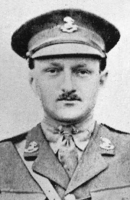
CPL David Wallace Crawford
1887 - 1916
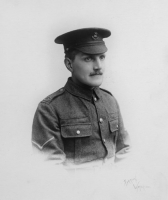
Lce-Corpl John Joseph Nickle
1894 - 1916
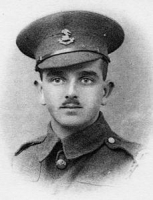
Pte 17911 Morton Neill
1897 - 1916
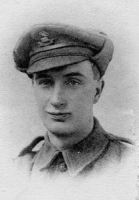
Lieut Edward Stanley Ashcroft
1883 - 1918
Pte 32795 John Walter Griffiths
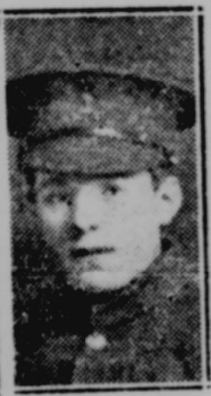
- Age: 19
- From: Liverpool
- Regiment: The King's (Liverpool Regiment) 18th Btn
- K.I.A Wednesday 18th October 1916
- Commemorated at: Warlencourt Brit Cem
Panel Ref: V.F.39
John Walter (Jack) Griffiths was born in Liverpool on 01st May 1897, the son of James Henry Griffiths and his wife Mary Emma (née Doyle), who married in 1888 at St Ambrose's Church, Everton. Jack was the eldest surviving son, and the fifth of 12 children, two of whom died young. He had older sisters Annie, Emma, Margaret, and Ellen, and younger siblings Thomas, Katie, James, Nora, and Albert. He was baptised in St. Peter's Church, Liverpool, on 17th May 1897, his parents’ abode Cornwall Street, his mother’s name given as Emma, and his father’s occupation listed as labourer.
In 1891 the family are living at 67 Opie Street, Everton, father James is aged 21, a labourer in a sugar refinery born in Liverpool, mother Emma, aged 21, born in Newcastle, Durham, children Ann 1, and Emma 1 month, both born Liverpool. After this census his mother’s birthplace is then shown as Liverpool.
In 1901 the family are living at 84 Opie Street, Everton, his father is not present and his mother, aged 31, is head of household, with six children: Annie 11, Emma 10, Margaret A. 8, and Ellen 6, John W. is 3, and James 1. They have a boarder Henry Carr 45 from Liverpool.
He enlisted in Liverpool and was serving in the 18th Battalion, The King’s Liverpool Regiment as Private No 32795 when he was killed in action on the 18th October 1916 during the Battle of the Transloy Ridges which was part of the ongoing Somme Offensive.
18th Battalion Diary
18th October 1916
Attacked German trenches commencing 3.40 am. Relieved by 19th Manchester Regt. Took up position in support Bn trenches W. of Goose Alley.
Graham Maddocks in his book Liverpool Pals gives an overview of the events of the day:
“At 3.40 am the whistles blew, and the Battalion left its assembly trenches, in three waves, approximately fifty yards apart, and began to cross No Man’s Land. Almost immediately, the German Barrage fell on the first wave and halted its advance, so that the second wave soon caught up with it. This was not a great problem at first, and the two combined waves were able to advance together for about 300 yards, whereupon they encountered the German Grid Trench system. On the right of the advance, it was found that the wire was largely intact, apart from a few gaps, and the Germans bombed and machine gunned these gaps, which prevented any further progress. Elsewhere along the trench, however, the wire was cut and there did not seem to be any serious opposition. Nevertheless, the men hesitated to jump down into the German trenches, and instead, began to filter back across to the safety of their own lines.
By this time the third wave had caught up, as had a fourth wave, which had been detailed to mop up any opposition once the trenches had fallen, and all four waves became intermingled which added to the confusion. No less than three attempts were made to try to get the men to go forward again, but each attempt became markedly less successful than its predecessor, and eventually the attack came to a standstill. Although the British assembly trenches had received the attention of the German guns, the attackers in No Mans Land had not come under any great intensity of fire up until this point.
However, once it became obvious to the Germans that the attack was disorganised and faltering, they began to fire into the massed men from the flanks. It was probably this that finally settled the issue and convinced the Pals that they could no longer gain the enemy trenches, and all four waves, now merged into one, began to retreat to their own lines. The whole attack had been an abysmal failure, and no ground had been gained at all”.
He was listed amongst the Missing in the Liverpool Weekly Courier on Saturday 25 December 1916:
Missing Soldiers.
Information concerning the following soldiers who are reported missing at the front will be welcomed at the addresses given:-
Pte John Walter Griffiths, K.L.R. is reported missing. Information regarding him will be welcomed by Mrs Griffiths, of 7 Leycester Street, off Wilbraham Street, Liverpool.
Jack earned his two medals.
He now rests at Warlencourt British Cemetery, France.
Warlencourt Cemetery is entirely a concentration cemetery, begun late in 1919 when graves were brought in from small cemeteries and the battlefields of Warlencourt and Le Sars. The Graves Registration form shows graves from “Le Sars 6/1, 6/2, Hexham Road, Seven Elms”.
Graves were brought in from the original cemeteries at Hexham Road (Le Sars), and Seven Elms (Flers), as well as over 3,000 British graves due to the fighting which took place around the Butte de Warlencourt from the autumn of 1916 to the spring of 1917, and again in the German advance and retreat of 1918. The cemetery now contains 3,505 Commonwealth burials and commemorations of the First World War, 1,823 of which are unidentified.
We currently have no further information on John Walter Griffiths, If you have or know someone who may be able to add to the history of this soldier, please contact us.
89th Brigade On This Day.
110 Years Ago.The Battle of the Transloy Ridges begins. more....
Killed On This Day.
(110 Years this day)Sunday 15th October 1916.
Pte 30280 James Patrick Doyle
25 years old
(110 Years this day)
Sunday 15th October 1916.
Pte 34608 Thomas Foster
19 years old
(110 Years this day)
Sunday 15th October 1916.
Pte 53107 Joseph Green
32 years old
(110 Years this day)
Sunday 15th October 1916.
Pte 11282 Stephen Hynes
21 years old
(110 Years this day)
Sunday 15th October 1916.
Pte 32717 Evan Lee
25 years old
(110 Years this day)
Sunday 15th October 1916.
Pte 34271 James Vickers
21 years old
(108 Years this day)
Tuesday 15th October 1918.
Cpl 15764 Alan Douglas Ellison
30 years old