
1885 - 1916
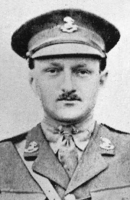
CPL David Wallace Crawford
1887 - 1916
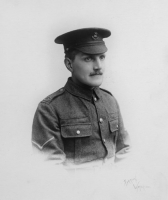
Lce-Corpl John Joseph Nickle
1894 - 1916
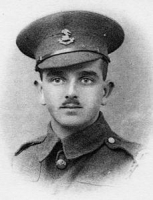
Pte 17911 Morton Neill
1897 - 1916
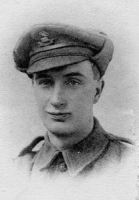
Lieut Edward Stanley Ashcroft
1883 - 1918
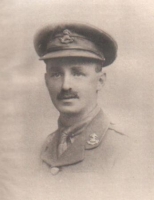
L/Cpl 15736 John Graham Goodfellow
- Age: 28
- From: Wincanton Somerset
- Regiment: The King's (Liverpool Regiment) 17th Btn
- K.I.A Sunday 30th July 1916
- Commemorated at: Guillemont Rd Cem
Panel Ref: II.O.8
John (Jack) Graham Goodfellow was born in Wincanton in mid June 1888, the son of William Theodore Goodfellow and his wife Bessie Agnes (nee Summers). William, born in Wincanton, and Bessie, from Exeter, married in 1885. Jack was the middle of their three sons. He was baptised on 17th July 1888 in the Wincanton Parish Church, St. Peter and St. Paul. His father's occupation was given as coachbuilder.
At the time of the 1891 census William and Bessie were the proprietors of the Greyhound Hotel in Market Place, Wincanton. William is also listed as a coach builder. Jack is 2 and has a 4 year old brother called Leslie William. The family keep the hotel from 1889 to 1895.
By the time of the 1901 census the family are living at South Street in Wincanton where William is now recorded as a coach builder. They have another son called Montague Edgar who was born in 1892. They also have a domestic servant, 16 year old Maud Sparrow. Leslie, 14, is at boarding school in Bruton, Somerset, just a few miles from Wincanton.
Their son Leslie emigrated to America in 1908.
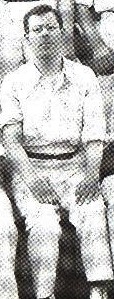
Jack was a keen cricketer and played for Wincanton cricket team. The photograph on this site is from a team photo for Wincanton CC.
By 1911 Jack has moved to Liverpool and is living in a boarding house at 2 Louden Grove in Toxteth. He is aged 22 and is a qualified marine engineer having served as an apprentice with the London and South West Railway Company.
His parents are still in South Street (the property is described as a cottage with adjoining garden, coachbuilding yard and outbuildings). His father, 58, is a coachbuilder/employer working at home, his mother is 44. Montague, 19, is living in Bristol and working as a bank clerk.
Jack’s father, William, was a well known figure in Wincanton as a local sportsman and community organiser. He was captain of the Wincanton fire brigade and on 24th February 1914 attended a major fire at Redlynch House near Bruton. He sustained a severe chill and died on 28th February 1914 from double pneumonia at the age of 61. The fire was reported in the press and blamed on suffragettes. William was given an effusive memorial in the local newspaper who noted appreciation for his success in the role of secretary and treasurer of the Wincanton Steeplechase, as well as giving his time and efforts in all sorts of local events. “Nothing seemed to be too much trouble for him and the time he gave freely for the public welfare it is difficult to estimate” The article noted that Jack was an engineer on a steam ship and was on his way home, but did not make it in time for his father’s funeral.
His death was reported in the Western Gazette on 13th March 1914:
All Persons having any CLAIMS on the Estate of William Theodore Goodfellow, late of South Street, Wincanton, Somerset, Coachbuilder, who died on the 28th February 1914, ARE REQUESTED to SEND PARTICULARS thereof to me, and Persons INDEBTED to the Estate ARE REQUESTED PAY me the sums due from them.
Dated 10th March, 1914.
JNO. O. CASH, Solicitor, Wincanton.
Jack enlisted on 02nd September 1914 at St George's Hall in Liverpool joining the 17th Battalion, The King’s Liverpool Regiment as Private 15736. He gave his age as 26 years and 79 days and his occupation as an Engineer. He was six feet and three quarter inches tall, weighed 148lbs, 38" chest with a fresh complexion, hazel coloured eyes and brown hair. He stated his religion as Church of England and gave his next of kin as his mother, who was by then living at 183 Wells Road, Knowle, Bristol.
He was billeted at Prescot Watch Factory from 14th September 1914, he trained there and also at Knowsley Hall. On 30th April 1915 the 17th Battalion alongside the other three Pals battalions left Liverpool via Prescot Station for further training at Belton Park, Grantham. They remained here until September 1915 when they reached Larkhill Camp on Salisbury Plain.
His service records show:
04.6.15: At Grantham: Creating disturbance after lights out. Three days confined to barracks.
31.7.15: At Grantham: Late returning from furlough. Five days confined to barracks.
16.9.15: Appointed unpaid Lance Corporal.
07.11.15: Embarked for France with his battalion.
06.3.16: In the field: Not complying with Battalion Orders in Camp. Severely reprimanded 8.3.16:
19.4.16: He moved to HQ 89 Brigade.
He was reported Missing in action 30th July 1916 during the attack on Guillemont. He was 28 years of age.
17th Battalion Diary
The Battalion was in support to 19 & 20 Battalions K.L.R. 2 Coys. behind 19th & 2 Coys. behind 20th. Very thick mist. The attack was pushed home to the objective in places but in the main was held up by machine gun fire from hidden machine guns.
Fighting continued all day swaying backwards and forwards until by 6pm about 300 yards in depth had been gained & consolidated all along our front.
Casualties in the 17th Battalion were 15 Officers and 281 Other Ranks
Further details are reported in more detailed by Everard Wyrall in his book The History of the King’s Regiment (Liverpool) 1914-1919 Volume II 1916-1917
The 17th King’s had advanced (two companies each behind the 19th and 20th Battalions) in small columns. They too suffered heavily from machine-gun fire and were quickly absorbed into the waves that preceded them. They also shared the gains and losses of that terrible day.
When darkness fell on the battlefield the 30th Division held a line from the railway on the eastern side of Trones Wood , southwards and including Arrow Head Copse, to east of Maltz Horn Farm. On this line the division was relieved by the 55th Division during the early hours of the 31st July.
The events of 30th July 1916 were regarded at the time as Liverpool’s blackest day. There follows an extract from The History of the 89th Brigade written by Brigadier General Ferdinand Stanley which gives an indication of the events of the day.
Guillemont
Well the hour to advance came, and of all bad luck in the world it was a thick fog; so thick that you couldn’t see more than about ten yards. It was next to impossible to delay the attack – it was much too big an operation- so forward they had to go. It will give some idea when I say that on one flank we had to go 1,750 yards over big rolling country. Everyone knows what it is like to cross enclosed country which you know really well in a fog and how easy it is to lose your way. Therefore, imagine these rolling hills, with no landmarks and absolutely unknown to anyone. Is it surprising that people lost their way and lost touch with those next to them? As a matter of fact, it was wonderful the way in which many men found their way right to the place we wanted to get to. But as a connected attack it was impossible.
The fog was intense it was practically impossible to keep direction and parties got split up. Owing to the heavy shelling all the Bosches had left their main trenches and were lying out in the open with snipers and machine guns in shell holes, so of course our fellows were the most easy prey.
It is so awfully sad now going about and finding so many splendid fellows gone.
He was reported as Missing in the Bristol Times and Mirror on 14th September 1916:
King’s (Liverpool Regiment) – Goodfellow, 15736, J. G. (Bristol);
His brother Montague in Holland (address c/o R.N.D. Library, Interneeringsdepot, Groningen) contacted the International Red Cross in hopes that Jack (C" Company, 12th Platoon) had been taken prisoner. The ICRC card shows that a response was sent on 20th July 1916 (sic): "According to letter of 09th October 1916 L/C Goodfellow was killed."
Jack's body had been found and he was buried on 05th September 1916 by men of 4th Battalion Loyal North Lancashire Regiment. After the war, when graves were concentrated, his body was removed and reinterred in Guillemont Road Cemetery where he now rests.
Guillemont was an important point in the German defences at the beginning of the Battle of the Somme in July 1916. It was taken by the 2nd Royal Scots Fusiliers on 30 July but the battalion was obliged to fall back, and it was again entered for a short time by the 55th (West Lancashire) Division on 8 August. On 18 August, the village was reached by the 2nd Division, and on 3 September (in the Battle of Guillemont) it was captured and cleared by the 20th (Light) and part of the 16th (Irish) Divisions. It was lost in March 1918 during the German advance, but retaken on 29 August by the 18th and 38th (Welsh) Divisions.
The cemetery was begun by fighting units (mainly of the Guards Division) and field ambulances after the Battle of Guillemont, and was closed in March 1917, when it contained 121 burials. It was greatly increased after the Armistice when graves (almost all of July-September 1916) were brought in from the battlefields immediately surrounding the village.
Guillemont Road Cemetery now contains 2,263 Commonwealth burials and commemorations of the First World War. 1,523 of the burials are unidentified but there are special memorials to eight casualties known or believed to be buried among them.
The cemetery was designed by Sir Herbert Baker.
His mother, Bessie, received his personal effects which included 1 disc, 1 Iron Cross and 2 charms.
Jack's Army pay was shared between his mother and brother Leslie, and the War Gratuity of £8-10 between his mother and Montague.
Probate in the name of Jack Graham, Private, 17th Bn., was granted to Montague, effects of £102-7s-6d.
In 1919 his mother Bessie was at 183 Wells Road with Montague, 27. Leslie, 33, was in Montana.
His mother subsequently moved to Bristol to be near her son Montague, she died in the September quarter of 1935, aged 69.
Montague also served his country in the Naval Brigade and took part in the defence of Antwerp in October 1914.The Brigade were forced to withdraw to England, some 1500 of them were trapped in Antwerp and were forced to cross the border into neutral Holland, Montague was amongst them and he was interned in Holland for the duration of the war. He served many years in the RNVR reaching the rank of Paymaster Commander.
Jack is one of the 35 names of local men who lost their lives in WW1 listed on the memorial stained glass window in St Peter and St Paul Church in Wincanton. He is also commemorated on the family gravestone in Wincanton Cemetery.
We currently have no further information on John Graham Goodfellow, if you have or know someone who may be able to add to the history of this soldier, please contact us.
89th Brigade On This Day.
110 Years Ago.The Battle of the Transloy Ridges begins. more....
Killed On This Day.
(110 Years this day)Monday 16th October 1916.
Pte 22929 Edward Bird
19 years old
(110 Years this day)
Monday 16th October 1916.
Pte 16795 William Frederick Collister
23 years old
(109 Years this day)
Tuesday 16th October 1917.
L/Cpl 49038 Ernest Yardley
31 years old
(108 Years this day)
Wednesday 16th October 1918.
Pte 85187 James Hoy
31 years old
(107 Years this day)
Thursday 16th October 1919.
Pte 36438 Hugh Morris
23 years old