Menu ☰
Liverpool Pals header
Search Pals

Search
Capt Arthur de Bells Adam (MC)
1885 - 1916


CPL David Wallace Crawford
1887 - 1916

Lce-Corpl John Joseph Nickle
1894 - 1916

Pte 17911 Morton Neill
1897 - 1916

Lieut Edward Stanley Ashcroft
1883 - 1918
Lieut Edward Stanley Ashcroft

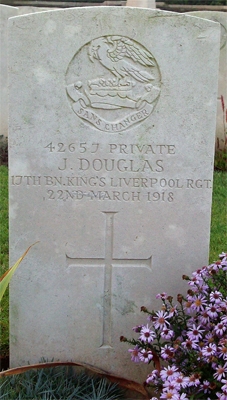
Pte 42657 John Douglas


  • Age: 33
  • From: Whitehaven
  • Regiment: The King's (Liverpool Regiment) 17th Btn
  • K.I.A Friday 22nd March 1918
  • Commemorated at: Chapelle Brit Cem, Holnon
    Panel Ref: I.F.19

John Douglas was born in the December quarter of 1884 in Whitehaven to Cockermouth born mercantile seaman, John Douglas, and his Cockermouth born wife Sarah (nee Reay). They married in the December quarter of 1884, the marriage being registered in the Penrith district. Sarah was the widow of William Ellwood, whom she had married in the March quarter of 1871. They had a son Thomas Ellwood and a daughter Mary Ellen Ellwood who she brought to the marriage. John was their third son of three children they had together. He had older brothers Robert born 1880 and William born 1882.

His father, John Douglas, drowned on the 18th September 1889 when the S.S.Florence foundered off the Isle of Man. He was born in Dumfries, Scotland in 1854, he was just 35 when he lost his life.

His death was reported in the Cumberland Pacquet, and Ware's Whitehaven Advertiser on Thursday 26th September 1889 under the header:

CUMBERLAND SAILORS DROWNED.

Details are given of the loss of the steamer Florence, of Liverpool, 200 tons, off the Calf of Man. The Isle of Man steamer King Orrey, from Liverpool, was about twenty miles off Douglas Friday evening, when the passengers noticed a small object in the water. Captain Ruthven's attention being called, he had the steamer put about, and the object was found to the battered wreck of the steamer's lifeboat, with a man lying apparently lifeless across the stern, with his head almost in the water, and with nothing on except a singlet and drawers, and nearly black with exposure. There was another man standing in the boat, nearly to his waist in water, holding up a boathook with pair of oil skin breeches on the end. Some difficulty occurred in lowering a boat from the steamer, but seaman, Joseph Neale, lowered himself at great risk and fastened a rope round the man's body, and afterwards around the apparently lifeless-body. They were hauled board, and an attempt was made to resuscitate the second man, but he died ten minutes after being rescued. The other man recovered on being taken to the hospital. A subscription was started on board for him, and a portion was offered to Neale for his bravery, but refused it, and the whole sum was handed to the survivor of the Florence. The Press Association’s correspondent saw the man, whose name is William O'Neill, and he gave a narrative of the wreck. He said the Florence was in the command of Captain Cameron, a Scotchman, living in Liverpool, and she left Garston on Wednesday evening. The crew consisted of Captain, mate, two engineers, two firemen, lampman, cook, and two men before the mast, as well a passenger, whose name O’Neill did not know. The Florence had a heavy cargo of coal for Belfast. The ship had reached the vicinity of the Calf of Man, and had got between the Calf and the Chicken light. Only the mate and O’Neill were on deck, and the latter went below to trim the binnacle lamp, the mate taking his place at the wheel meanwhile. There was heavy rain falling, and a dirty sea running. When O’Neill returned with the lamp, the second engineer came up and said, "She is full aft." O'Neill told the mate, who said, "Not at all.'’ O'Neill ran aft, and saw some of the hatches had gone. The mate told him to call the Captain, but that was impossible. They therefore blew the whistle, and the Captain came up. The mate told him the vessel was full aft. The Captain looked, and then ordered the boats out, then took hold of the wheel, but they had not time to get the boats out before the vessel went down. O'Neill was swimming about in the water for a quarter of hour before he came across the lifeboat, bottom upwards. Another man was also swimming about, and they managed to get on the keel. They sat on the keel for two days, when the boat righted, and they got into her. There was a big hole in her, and she was so low in the water that passing vessels could not see her. His companion's name was Michael Grace, a native of Dublin. He had a terrible time in the boat, was pulling the oar with O’Neill for about two hours before the King Orrey picked them up, but he then gave up, completely exhausted. O'Neill said this was the third time he had been shipwrecked. O'Neill's limbs are swollen a little, and he has a touch of rheumatism, but these are the only effects he feels of his long exposure, a man of tough physique, though neither tall nor stout.

An inquest was held at Douglas on Saturday on the body of Grace. William O'Neill, sole survivor, said their boat was passed upwards of forty vessels on Thursday, but it was so low in the water they could not be seen. The jury returned a verdict of death from exposure and exhaustion. Grace was buried at Douglas on Sunday, the expenses of the interment being borne by his countrymen living in the town.

The Florence was well known at this port, a regular trader; although she had not been much here of late. She belonged to Messrs. Mack, of Liverpool, and was on a voyage to Belfast, from whence she was coming to Whitehaven to load rails for Liverpool. Mr. Howie was the local agent.

Amongst the crew are John Douglas, of Quay-street, in this town, and two Workington men, whom one, John Wilson, was the mate. The other was named John Phillipson. Douglas, we are sorry to say, leaves a widow and six children, and Mr. Howie is engaged in raising a subscription for their benefit. Over £18 has been collected. Captain Cameron, of the Florence, was a skilful and careful seaman. He belonged to Kircudbrightshire, his father traded to this port for many years. It is generally supposed that the Florence foundered owing to her shipping water through the hatchways. Indeed, O'Neill has since stated that this was the cause.

It seems by the disaster to the Florence seven women have been made widows and between 30 and 40 children orphans. Towards the assistance of these a public subscription was being got up. The owners, J. and J. Mack and Sons, Oriel Chambers, Water-street, Liverpool, are the prime movers this object, while the North and South Wales Bank, in Castle-street, Liverpool, as well as the owners, will receive subscriptions. The widows of Captain Cameron and the chief engineer, Williams, live next door to each other, and have been left respectively with six and four orphan children to provide for. It may happen that some of the bodies of the crew may be washed ashore, and in this case it is the only hope of ever gleaning the name of the only passenger, an unfortunate man who begged for passage to his death.

(To the editor of The Cumberland Pacquet.)

Sir, A Whitehaven man named Douglas was one of the crew of the S.S. Florence which was lost last week under circumstances which must have attracted the sympathetic attention of all your readers. Douglas has left behind him a widow in a delicate state of health, and four young children. These are quite unprovided for. For 6 months before he took the ill-fated voyage Douglas was out of work and through this the family are now destitute. Comments on this fact is unnecessary. This case is one of exceptional hardship, and I would venture to ask a generous public for that assistance on behalf of the unfortunate survivors, which in such an emergency is never lacking. Contributions towards this object will be gladly received by Mr H. Howie, of this town - who has already opened a subscription list - or by yours &c.,

THOMAS BOWMAN.

Whitehaven, September 25th

The Cumberland Pacquet, and Ware's Whitehaven Advertiser reported of a fundraising event in the edition of 24th October 1889

Concert in the Market Hall.—On Saturday evening concert was given in the Market Hall, in aid of the widow and children of John Douglas, who was lost by the foundering of the s.s. Florence off the Calf of Man in September last. Mr. T. Bowman was chairman. There was not large audience, but a good many tickets were sold. All the performers, who kindly gave their services, acquitted themselves well.

His widow Sarah is the head of household on the April 1891 Census at 8 Quay Street, Whitehaven and is a shopkeeper. She lives with her five children from her two marriages. These are listed as; Thomas Ellwood a 17 year old labourer born in Brampton, Mary E. Ellwood aged 15 also born in Brampton, Robert Douglas aged 11 born in Maryport, William aged 8 born in Whitehaven and John who is aged 6.   
 
The 1901 Census shows John as a general labourer, aged 16 still living at 8 Quay Street, Whitehaven with his 21 year old elder brother Robert a pit bank labourer as the head of the household. Their mother appears to have gone into domestic service living elsewhere. 
 
The Census of 1911 shows John as a 26 year old hairdresser living at 103 Queen Street, Whitehaven. He is one of three people lodging with Sarah Jane Quinn a grocer and general dealer and her 18 year old daughter Annie Maratty Quinn. 

John married Annie Maratty Quinn on 03rd January 1912 at Whitehaven Registry Office. On his marriage certificate he is shown as a barber, age 26, Bluebell Lane, Tangier St, Whitehaven. Annie was 21, 101 Queen St, Whitehaven.
 
In the June quarter of 1912 they have a daughter named Bessie Douglas but sadly she died a few months later in the  December quarter of 1912. On 06th December 1913 they have a son William John Douglas who was born in Whitehaven. 

John enlisted in Liverpool and was originally posted to the 20th Battalion of The King's Liverpool Regiment as Private 42657.

The 31 field hospital train lists him as wounded near Warlincourt with a back injury between 09th April 1917 and 10th April 1917 with the 20th Pals before being returned to duty. This injury was sustained during the opening phase of the Battle of Arras.

Following the disbandment of the 20th Battalion in France in February 1918 he was transferred to the 17th Battalion of The King’s Liverpool Regiment.

John was originally reported as Missing, during the German Spring Offensive. His death was later presumed to have occured on 22nd March 1918 and his record changed to Killed in Action. He was 33 years of age.

At the time of his death, the 17th Battalion had been ordered to the defence of the area around Atilly, to try to counter the rapid German advance. At 6.30 am ’D’ Company was sent to help the 2/5th Battalion The Gloucestershire Regiment to counter attack the Germans in the area of Holnon Wood, which it did successfully. Four hours later, the Battalion was ordered to move to a position know as Aviation Wood, to join the Headquarters of the 21st Brigade, but because of heavy shellfire, this move took four hours, and by the time the 17th Battalion had got there, the HQ and staff of the Brigade had gone. Then, as the Germans were making a strong attack at nearby Flesquires, the Battalion deployed around the wood. Eventually at 18.30 orders were received that all 30th Division troops had to withdraw to Ham, and the Battalion accordingly pulled back, reaching the town at around 21.30. 

John now rests at Chapelle British Cemetery, Holnon, France.

Holnon village and wood were the scene of heavy fighting between the 6th Division and the enemy on the 14th-19th September, 1918.

Chapelle British Cemetery, named from a wayside shrine, was made after the Armistice, by the concentration of graves of 1917-18 from the battlefields West of St. Quentin and from HOLNON COMMUNAL and FRENCH MILITARY CEMETERIES.

There are now over 600, 1914-18 war casualties commemorated in this site. Of these, over 250 are unidentified and special memorials are erected to 17 soldiers, known or believed to be buried here. Other special memorials record the names of four United Kingdom soldiers, buried in Holnon Communal Cemetery, whose graves were destroyed by shell fire.

The cemetery covers an area of 2,063 square metres and is enclosed by a low rubble wall.

His pay arrears was paid with a War Gratuity to his widow Annie on 18th July 1919 and 17th September 1919. She and his son John were also awarded a weekly dependants pension from 25 November 1918 to their address at 43 Queen Street, Whitehaven. 
 
On 21st February 1921 she remarried in Whitehaven to a 31 year old general labourer George Wren.

Annie died tragically on 09th October 1922, aged 29  whilst in childbirth with twin boys, one of whom died with her. 
 

We currently have no further information on John Douglas. If you have or know someone who may be able to add to the history of this soldier, please contact us.

Killed On This Day.

(109 Years this day)
Sunday 22nd April 1917.
Pte 52865 Hyman Barnett Gadansky
28 years old

(108 Years this day)
Monday 22nd April 1918.
Pte 136181 Edwin Williams
19 years old