
1885 - 1916
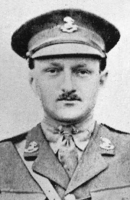
CPL David Wallace Crawford
1887 - 1916
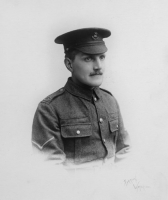
Lce-Corpl John Joseph Nickle
1894 - 1916
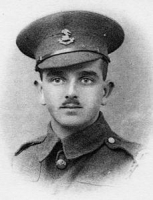
Pte 17911 Morton Neill
1897 - 1916
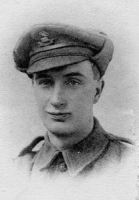
Lieut Edward Stanley Ashcroft
1883 - 1918
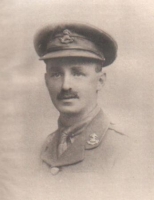
Pte 17574 Thomas Spencer Delaney
- Age: 25
- From: Liverpool
- Regiment: The King's (Liverpool Regiment) 19th Btn
- K.I.A Sunday 30th July 1916
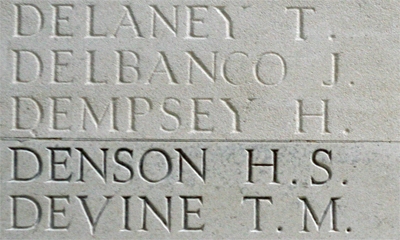
- Commemorated at: Thiepval Memorial
Panel Ref: P&F1D8B &8 C.
Thomas Spencer Delaney was born on the 28th September 1889 in Liverpool and was baptised on the 06th October 1889 at St Francis Xavier, Liverpool. He was the son of Thomas Patrick Delaney and his wife Elizabeth Mary (nee Smyth) who were married on the 9th Sept 1888 at Our Lady of Immaculate Conception, St Domingo Rd. Thomas Patrick was of 45 Standish St, father Patrick, whilst Elizabeth was of 127 Everton Terrace, father John.
Thomas was educated at St Francis Xavier school and records show his date of birth as 28th September 1890. His parents married in 1888. Thomas had younger siblings Philip Richard and Evelyn Sarah.
The 1891 Census shows the family living at Spencer Street, Everton, Liverpool.
His father Thomas is aged 24, born in Liverpool in 1867 is a grocer’s assistant, whilst his mother, Elizabeth, is aged 25, born 1866 in Liverpool and has no occupation listed. They have a son Thomas aged 1, born in Liverpool.
The 1901 Census shows the family living at 47, Aubrey Street, Everton, Liverpool.
His father Thomas aged 34, is a professional vocalist and his wife Elizabeth is aged 35, but Census shows she was born in Ireland. At the time of the Census they have three children, Thomas aged 11, Philip aged 5, born 1896 and Evelyn aged 3, born 1898. Also at the address are the father’s two brothers, John aged 32, born 1869 employed as an electrical engineer and Richard aged 28, born 1873 who is a butcher’s manager. There is a boarder named John Green aged 36, born 1865 and he is a book keeper.
His father, Thomas Delaney, previously with the Liverpool Opera Society and a grand opera company, "an exceptionally fine baritone vocalist", became a music hall entertainer and is found touring in various towns around Lancashire (Liverpool, Manchester, and Blackpool, among others), from 1895 through the early 1900s.
He died in Lytham at the age of 38, reported in the Preston Herald on 08th November 1905:
"Widespread regret has been caused at Lytham by the death of Mr. Tom Delaney, who was very popular among all classes of residents as a comedian and vocalist. For years he had been one of the foremost members of Mr Geo. Kingston's troup of pierrots." He was buried in Ford Cemetery, Liverpool.
On 1911 Census, his widowed mother Elizabeth is aged 45, born in Dublin, is living at 114 Queens Road, Everton. Philip, 15, and Evelyn, 13, are at school. His uncle John James Delaney, 42, is still with them, in addition to two other boarders. Thomas is not with the family and he has not been found on any census or crew list.
Thomas enlisted at St George's Hall, Liverpool on 4th September 1914, joining the 19th Battalion, The King’s Liverpool Regiment as Private No 17574. He gave his age as 24 years and 350 days, and his occupation as clerk. He was described as being 5' 11" tall, weighing 128 lbs, 34” chest, with a sallow complexion, grey eyes, and fair hair, with a scar on his right cheek. He stated his religion as Roman Catholic, and as next of kin his mother at 114 Queens Road, later 39 Breck Road.
Formed on 07th September 1914 the 19th Battalion trained locally at Sefton Park and remained living at home or in rented accommodation until November 1914. They then moved to the hutted accommodation at Lord Derby’s estate at Knowsley Hall. On 30th April 1915 the 19th Battalion alongside the other three Pals battalions left Liverpool via Prescot Station for further training at Belton Park, Grantham. They remained here until September 1915 when they reached Larkhill Camp on Salisbury Plain.
At Belton Park in June 1915, he was 3 days confined to barracks for being absent from early morning parade.
At Larkhill, for being absent without leave from 11:55 p.m. on 2/10/1915 to 7 p.m. on 4/10/1915, he received 8 days' C.B. and forfeited 3(?) days' pay.
He reached France on 07th November 1915.
His service records show:
05/02/1916 Sick, to 98th Field Ambulance
07/02/1916 Admitted No.3 Field Ambulance with pleurisy.
18/02/1916 Rejoined his unit in the field
Thomas was killed in action on the 30th July 1916, aged 26, during the Battle for the village of Guillemont which was part of the ongoing Somme Offensive.
19th Battalion Diary 30th July 1916
MALTZ HORN FARM
BATTLE begun. ZERO hour 4:45 am. The Battalion reached its objective, but suffered heavy losses, and had to evacuate its position owing to no reinforcements.
Everard Wyrall gives details of the attack in his book The History of The King’s Regiment;
"The 2nd Attack on Guillemont- 29th July 1916 the 89th Brigade the 20th King's were to attack on the right and the 19th on the left. During the evening of the 29th the night was dark and foggy when the Battalions moved off and the 19th with Lt Col G Rollo commanding, when passing the South east of the Briqueterie they were heavily shelled first with H E and then with a new kind of asphyxiating Gas shell which had curious results, at first it had no nasty effect but about 8 hrs later men began to fall sick with violent headaches and pains in the stomach. All ranks had to wear gas masks which in the darkness and mist made the going terribly difficult. It was indeed wonderful that they were able to reach their Assembly point at all. But they did and by 2.45 a.m. on the 30th July 1916 the Btn was assembled having suffered about 30 Casualties on the way up ready for the Zero hour at 4.45 a.m.
It is known that the two left Companies of the 19th under Capt. Dodd and Capt. Nicholson advanced in touch with the 2nd Royal Scots Fusiliers on their left although they suffered many casualties from Machine gun Fire did not encounter many Germans and reached their final objective about the time allocated, beginning at once to dig in south of the orchard on the South east corner of Guillemont.
On the left of the 19th the Scots Fusiliers most gallantly forced their way through Guillemont to the eastern side of the village but were soon overwhelmed by the enemy and few returned.
At 8 a.m. finding that the village was not held the two left Companies of the 19th received no word from the rear or either flank believed themselves to be totally isolated so were forced to fall back and dig in, their position being untenable.
At midday the effective fighting strength of the 19th Btn was just 7 Officers and 43 other ranks"
When darkness fell on the battlefield the 30th Division held a line from the railway on the eastern side of Trones Wood , southwards and including Arrow Head Copse, to east of Maltz Horn Farm. On this line the division was relieved by the 55th Division during the early hours of the 31st July.
Casualties in the 19th Battalion were 11 Officers and 435 Other Ranks
The events of 30th July 1916 were regarded at the time as Liverpool’s blackest day. There follows an extract from The History of the 89th Brigade written by Brigadier General Ferdinand Stanley which gives an indication of the events of the day.
Guillemont
Well the hour to advance came, and of all bad luck in the world it was a thick fog; so thick that you couldn’t see more than about ten yards. It was next to impossible to delay the attack – it was much too big an operation- so forward they had to go. It will give some idea when I say that on one flank we had to go 1,750 yards over big rolling country. Everyone knows what it is like to cross enclosed country which you know really well in a fog and how easy it is to lose your way. Therefore, imagine these rolling hills, with no landmarks and absolutely unknown to anyone. Is it surprising that people lost their way and lost touch with those next to them? As a matter of fact, it was wonderful the way in which many men found their way right to the place we wanted to get to. But as a connected attack it was impossible.
The fog was intense it was practically impossible to keep direction and parties got split up. Owing to the heavy shelling all the Bosches had left their main trenches and were lying out in the open with snipers and machine guns in shell holes, so of course our fellows were the most easy prey.
It is so awfully sad now going about and finding so many splendid fellows gone.
He was later declared Killed in Action on 30th July 1916.
Thomas' body was not recovered or was subsequently lost as he has no known grave and is commemorated on the Thiepval Memorial in France.
The Thiepval Memorial, the Memorial to the Missing of the Somme, bears the names of more than 72,000 officers and men of the United Kingdom and South African forces who died in the Somme sector before 20 March 1918 and have no known grave. Over 90% of those commemorated died between July and November 1916.
On 01st August 1932 the Prince of Wales and the President of France inaugurated the Thiepval Memorial in Picardy. The inscription reads: “Here are recorded the names of officers and men of the British Armies who fell on the Somme battlefields between July 1915 and March 1918 but to whom the fortune of war denied the known and honoured burial given to their comrades in death.”
Thomas was initially declared Missing the Liverpool Daily Post on the 18th Sept 1916.
King’s(Liverpool Regiment) - Delaney, 17574, T.;
His mother appealed for information in the local press on 12th September 1916.
Private T. Delaney, K.L.R., is reported missing. Any information will be thankfully received by his mother at 34 Dinorwic Road, Anfield.
Thomas' outstanding Army pay was shared between his mother and brother Philip. His mother received a War Gratuity of £8-10s and was awarded a pension of 7/- a week.
In 1919 his mother was still in Dinorwic Road, with Philip, 23, and Evelyn, 21.
In February 1922, his mother, Elizabeth, wrote to Infantry Records
"Dear Sir,
I have received a form from the Pension Authorities containing various questions, one of which is the name and address of my son's employer when he joined the Army. My son joined up in the early part of September 1914 and I cannot recollect either the name or the address of his employer, as he must have given this information on enlisting I am writing to you to see if you can procure this for me.
Trusting you will be able to do so,
I remain,
Elizabeth Delaney."
She was informed in reply that they did not hold the name of his employer, merely that his occupation was clerk.
Philip enlisted on 22nd October 1915 as Gunner 686330 in the R.F.A. He was discharged aged 21 on 05th May 1918 (sickness) with a Silver War Badge. Sadly, he died from his disease on 16th November 1922 at the age of 26. Unfortunately, his death occurred after the cutoff date so he was not considered a war casualty. His mother applied for a pension but none was granted.
Elizabeth and Evelyn stay on the Electoral Roll at 34 Dinorwic Rd until 1937 when they move to 15 Renville Road, Fairfield.
Elizabeth died in 1947, aged 82, and was buried on the 22nd Sept at Anfield Cemetery RC.
Thomas is commemorated in Liverpool's Hall of Remembrance, Panel 7, Right
We currently have no further information on Thomas Spencer Delaney, If you have or know someone who may be able to add to the history of this soldier, please contact us.
89th Brigade On This Day.
110 Years Ago.The Battle of the Transloy Ridges begins. more....
Killed On This Day.
(110 Years this day)Monday 16th October 1916.
Pte 22929 Edward Bird
19 years old
(110 Years this day)
Monday 16th October 1916.
Pte 16795 William Frederick Collister
23 years old
(109 Years this day)
Tuesday 16th October 1917.
L/Cpl 49038 Ernest Yardley
31 years old
(108 Years this day)
Wednesday 16th October 1918.
Pte 85187 James Hoy
31 years old
(107 Years this day)
Thursday 16th October 1919.
Pte 36438 Hugh Morris
23 years old