
1885 - 1916
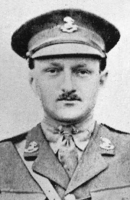
CPL David Wallace Crawford
1887 - 1916
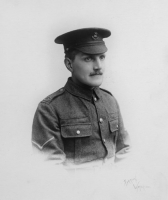
Lce-Corpl John Joseph Nickle
1894 - 1916
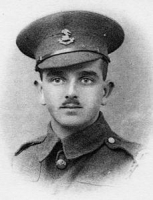
Pte 17911 Morton Neill
1897 - 1916
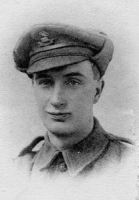
Lieut Edward Stanley Ashcroft
1883 - 1918
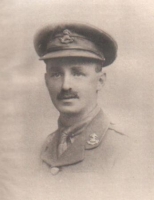
L/Cpl 16799 Joseph Currie

- Age: 20
- From: Aintree, Liverpool
- Regiment: The King's (Liverpool Regiment) 18th Btn
- K.I.A Sunday 20th August 1916
- Commemorated at: Gorre Brit Cem, Beuvry
Panel Ref: II.D.12
Joseph Currie was born 14th December 1895 in Aintree, Liverpool and was the son of Roger Currie and his wife Elizabeth (née Riley) who were married in early 1893 at St John the Evangelist Church, Walton on the Hill, Liverpool. He was baptised on the 06th January 1896 at St Mary's Church, Kirkdale, his father a labourer, of 35 Moffatt Road, Aintree.
The 1901 Census shows the family living at 27 Hartley’s Village, Fazakerley, Liverpool. The father Roger aged 28, born Everton, is a foreman in a jam works and his wife Elizabeth aged 27, born Liverpool, has no occupation listed. They have two children born in Fazakerley, Joseph aged 5 and Minnie Annie aged 1. They also have two boarders living at the address, William J. Davies aged 20, born 1881 in Swansea employed as a packer in a jam works and Fred Blease aged 21, born 1880 in Cheshire who is a groom (domestic).
The 1911 Census shows the family still living at 27 Hartley’s Village Fazakerley Liverpool. The father Roger aged 38, born 1873 is a general labourer in a jam factory and was born in Liverpool as was his wife Elizabeth aged 35, born 1876. They have been married for 18 years and have had six children of which two died. Joseph aged 15, born 1896 is a carter’s boy in a jam factory, Minnie Annie aged 11 born 1900 is at school, Helen aged 9, born 1902 and Donald aged 3, born 1908 are living at the address.
Another daughter, Ivy, was born in 1916.
Hartley’s Village in Aintree was built in 1886 by William Hartley when he moved his jam making business to what was then the outskirts of the city of Liverpool. The large factory site contained warehousing, offices, an engine house, railway sidings and access roads, as well as the main production factory itself. The village for his key workers initially had 40 houses, although this was later increased. It was designed to be self‐contained; in the square behind the houses were gardens, tennis courts and bowling greens for the resident workers to enjoy. The factory closed in the 1960s, and the site has since been designated a conservation area.
Joseph enlisted at St George's Hall in Liverpool on the 02nd September 1914 joining the 18th Battalion of The King's Liverpool Regiment as Private 16799. He gave his age as 19 years and 240 days and his occupation as a clerk. He was five feet five and a half inches tall, weighed 121 lbs, 34" Chest and of pale complexion, grey eyes and brown hair. He stated his religion as Church of England and next of kin father Roger, 31 Hartley’s Village.
From the 23rd September 1914 he was billeted at Hooton Park Race Course and remained there until 03rd December 1914 when they moved into the hutted accommodation at Lord Derby’s estate at Knowsley Hall. On 30th April 1915 the 18th Battalion alongside the other three Pals battalions left Liverpool via Prescot Station for further training at Belton Park, Grantham. They remained here until September 1915 when they reached Larkhill Camp on Salisbury Plain.
Whilst stationed in Lincolnshire, Joe became engaged to Ivy Firth.
07.11.15: Embarked for France with his battalion.
09.6.16: Appointed unpaid Lance Corporal in the field.
02.7.16: Appointed paid Lance Corporal in the field.
He was serving as Lance-Corporal No 16799 when he was killed in action on the 20th August 1916, aged 20, during the Somme offensive.
The Battalion diary for the 20th August records:
Givenchy (Left)
In Trenches:
Enemy showed somewhat increased artillery & rifle grenade activity. At 4pm a combined bombardment of the enemy salient at A.9 d. 77 took place and was very successful.
7.50 pm. Enemy sprung a mine (A.9 b. 23) in front of our line. This involved I sap & shook our parapets in places. Our artillery barrage excellenmt & also our Stokes and Trench mortars, rifle and Lewis Gun fire. Consolidation and occupation of the new crater was at once proceeded with and good observation post secured. Enemy oppostiion feeble.
Casualties 3 Killed.
Reconoitring patrols went out and found nothing special.
Casualties on 20th Aug.
16646 Corporal A.J. Campbell died of wounds (shell)
16799 L/Cpl J.Currie killed (rifle bullet)
23385 Pte G.Hyland killed(mine explosion)
26101 Pte J.Quinn““
32618 Pte S.M.Roe““
11621 Pte A.Rockcliffe““
He was reported as killed in the Liverpool Express on 08th September 1916;
Lance Corporal Joseph Currie K.L.R. 31 Hartley's Village, Aintree.
Also in the Daily Post 25th September 1916.
KILLED.
King’s (Liverpool Regt.) - Cannon, 58028, D. (Ramsey, Isle of Man); Currie, 16799, Actg. L.-CpL J.; Darcy, 14328. J.; Dodson, 26088, J.; Pry, 25139, J.; Hyland, 23385, G.; Kelly, 28206, A. (Ashton-under-Lyne); King, 8990, (Ellesmere Port); M'Henry, 12197, J.; Mawdesley, 8581, R.; Winrow, 6256, O. (Great Crosby).
Joseph now rests at Gorre British Cemetery, Beuvry, France, where his headstone bears the epitaph:
“GREATER LOVE HATH NO MAN THAN THIS FROM FATHER & MOTHER”
The chateau at Gorre was occupied early in the war by troops serving with the British Expeditionary Force and the Indian Corps, and the cemeteries, located in the south-east corner of original the chateau grounds, were begun in the autumn of 1914. The Indian section of the cemetery was closed in October 1915, shortly before the Indian infantry divisions left France for redeployment to the Middle East.
Many of those who now lie in plots V and VI of the British section of the cemetery were killed during the Battle of Estaires in April 1918. There are now over 930 Commonwealth servicemen of the First World War buried or commemorated here. The cemetery, which was designed by Charles Holden, also contains nine war graves of other nationalities, most of them German.
Gorre Chateau during the First World War
For much of the war, the chateau stood approximately four kilometres behind a section of the British front-line that ran northward along the Aubers Ridge from Givenchy-lès-la-Bassée to Festubert. From the end of the Battle of Festubert in May 1915 until the spring of 1918, this was considered a relatively ‘quiet’ sector. The village of Gorre was occasionally bombarded by German artillery during this period, but the chateau remained intact and its rooms were used as an officer’s mess and headquarters for British units stationed in the area. The grounds of the chateau were also the site of several artillery emplacements, a rifle range and an improvised parade ground and football pitch. Throughout 1916 and ’17 British troops could be seen drilling in the fields next to the chateau or unloading supplies from barges on the La Bassée Canal, which runs just south of the village.
The British section of the cemetery was used by infantry and artillery units stationed in the area until April 1918, when the relative quiet of the sector was shattered by the German Spring Offensive and Gorre became a support post close behind the front line during the Battle of Estaire. This battle was one of two massive German assaults on the Commonwealth positions from Ypres to Festubert that became known as the Battle of the Lys. When the battle erupted on 9 April, the 55th (West Lancashire) Division occupied the front-line trenches running north from Givenchy to Richebourg L’Avoué. The Allied positions to their left, around the village of Le Touret, were held by Portuguese units.
After a preliminary artillery bombardment that began on the evening of 7 April the German Sixth Army, spearheaded by storm troops, attacked in force early on the morning of the 9th. Heavy mist enabled the attackers to get very close to the Allied lines before they were observed and Portuguese units suffered heavy casualties and began to retire. Further south, the various formations of the 55th Division were hard pressed from the outset and the front line trenches around Givenchy were the scene of fierce fighting between British and German troops. The divisional brigade holding the northern section of the British line was forced to pull back, but well-organised counter-attacks and determined defence elsewhere enabled the 55th Division to hold its ground for the rest of the battle and prevent a major German breakthrough. Fighting continued in the trenches east of Gorre until 17 April when the German forces finally broke off the attack. In just over a week of fighting almost 3,000 officers and men of the Division had been killed, wounded, or taken prisoner, but the territory over which they had fought remained in Allied hands.
Soldiers Effects, army pay £4 3s 4d to his father Roger including a War Gratuity of £9 and a pension of 11 shillings a week to his mother Elizabeth.
On the first anniversary of his death in 1917 his family placed an In Memoriam notice in the Evening Express -
“In loving memory of our dear son Lce. Corpl. Joe Currie, K.L.R., killed in action Aug. 20, 1916. (Sadly missed by his mother and father, 31, Hartley’s Village, Aintree.)
As dawn crept over the trenches
You fell ‘midst shot and shell;
Our only grief we were not there
To bid you a last farewell.
But the hardest part is yet to come
When the heroes do return;
And we miss amongst the cheering crowd
Our son we loved so well.
Those happy hours we once enjoyed,
How sweet their memories cling.
(Never forgotten by his fiancée, Ivy Firth, Lincoln.)”
Another notice was placed in the press in 1918 -
“In loving memory of our dear son Lance Corpl. Joe Currie, killed in action Aug. 20, 1916. (Ever remembered by his mother and father, sisters and brothers, 21, Hartley’s Village, Aintree, and friends at Lincoln.)
We do not forget him, nor do we intend;
We think of him dearly and will to the end.
Oh, how we prayed for him, but all in vain,
What would we not give to see him again.”
It appears that Ivy, aged 23, married Willie Pearson in 1919 at St. Martin's Church, Lincoln. They appear on the 1939 Register with daughter Winifred at Newsums Villas, Lincoln.
In 1919 his parents still lived at 31 Hartley’s Village with Minnie 19, Ellen, 16, Donald, 12, Elizabeth, 6, and Ivy, 3 years old.
A son William was born later that year.
His mother Elizabeth died in 1922, aged 46. His father remarried in 1927 to Isabel Foster.
On the 1939 register his father Roger, now retired and 67 years old, still lived at 31 Hartley’s Village with wife Isabel, 54, and son William, aged 20, an assistant stock-keeper.
His father died in 1957 at the age of 84, and was buried in Kirkdale Cemetery with Joseph’s mother, Elizabeth, and daughter Ivy.
Joseph is commemorated on the following Memorials:
Hall of Remembrance, Liverpool Town Hall, Panel 8
Emmanuel C. of E. Church Fazakerley
Longmoor Lane, Council School
We currently have no further information on Joseph Currie, If you have or know someone who may be able to add to the history of this soldier, please contact us.
89th Brigade On This Day.
110 Years Ago.The Battle of the Transloy Ridges begins. more....
Killed On This Day.
(110 Years this day)Monday 16th October 1916.
Pte 22929 Edward Bird
19 years old
(110 Years this day)
Monday 16th October 1916.
Pte 16795 William Frederick Collister
23 years old
(109 Years this day)
Tuesday 16th October 1917.
L/Cpl 49038 Ernest Yardley
31 years old
(108 Years this day)
Wednesday 16th October 1918.
Pte 85187 James Hoy
31 years old
(107 Years this day)
Thursday 16th October 1919.
Pte 36438 Hugh Morris
23 years old