
1885 - 1916
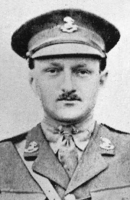
CPL David Wallace Crawford
1887 - 1916
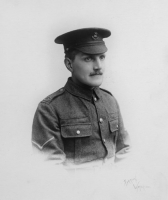
Lce-Corpl John Joseph Nickle
1894 - 1916
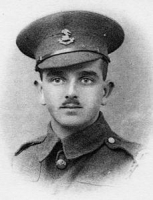
Pte 17911 Morton Neill
1897 - 1916
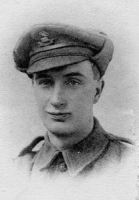
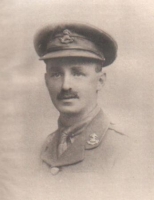
Lieut Edward Stanley Ashcroft
1883 - 1918
Pte 15209 Ernest Braga Cotton
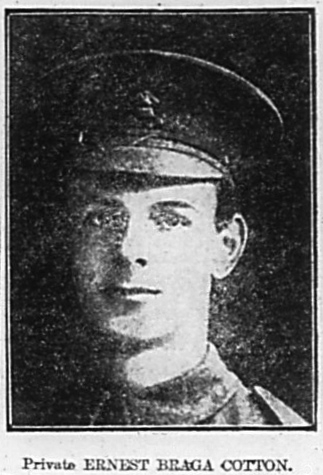
- Age: 20
- From: Woodchurch, Cheshire
- Regiment: The King's (Liverpool Regiment) 17th Btn
- K.I.A Sunday 30th July 1916
- Commemorated at: Thiepval Memorial
Panel Ref: P&F1D8B &8 C.
Ernest Braga Cotton was born in the second quarter of 1896 at Woodchurch, Birkenhead the son of Arthur Fernandez Cotton and his wife Maud (nee Harper) who married on the 22nd April 1893 at St Paul's Church, Birkenhead. Ernest’s great grandfather, Jose Marques Braga had been born in Portugal, came to live in Liverpool and traded as a merchant with Brazil. He also became vice consul to Brazil, and lived in a large house at 28 Ullet Road called Duaro Lodge (which still exists).
Arthur and Maud had three sons; Ernest had an elder brother Arthur Edward and a younger brother Thomas Eric.
The 1901 Census shows Ernest, his brothers and his mother living at 29 Alfred Road, Birkenhead. His mother is head of the household, stating that she is married and was born in Manchester in 1872. Ernest is shown as a 5 year old. His siblings are Arthur born 1894 in Liverpool and Thomas born in Birkenhead in 1900. Also present is a servant.
At the time of the 1911 Census Ernest, 15, and Eric, 11, are pupils in Deytheur Grammar School in Llansantffraid, Montgomeryshire, Wales.
His parents and brother Arthur live at 11 Osborne Road, Birkenhead, a 10-room house, with a domestic servant. His 42-year old father is a solicitor, his mother is 38. Arthur, 17, is a shipping clerk with Cunard.
Ernest enlisted at St George's Hall, Liverpool on 02nd September 1914 joining the 17th Battalion of The King’s Liverpool Regiment as Private No 15209.
He was billeted at Prescot Watch Factory from 14th September 1914, he trained there and also at Knowsley Hall. On 30th April 1915 the 17th Battalion alongside the other three Pals battalions left Liverpool via Prescot Station for further training at Belton Park, Grantham. They remained here until September 1915 when they reached Larkhill Camp on Salisbury Plain. He arrived in France on 7th November 1915.
The Birkenhead News reported that their father had two sons in the Army on 03rd October 1914:
Mr. A. F. Cotton's Sons.
Mr. A. F. Cotton (Messrs. Cecil Holden and Cotton) haS two sons in the Army. Arthur Edward, aged 20 years, is a Corporal in D Company, 4th Battalion Cheshire Regiment, and is at present billeted in Northampton. He has volunteered for foreign service. Mr. Ernest Braga Cotton, aged 18 years, enlisted in the 1st Liverpool Battalion of the King's Liverpool Regiment, at present at Prescot Barracks. He has also volunteered for foreign service.
Ernest was involved in the liberation of Montauban and the clearing of Trones Wood in July 1916 before the Pals attacked at Guillemont.
He was killed in action on the 30th July 1916, aged 20, at the village of Guillemont, France, during the Somme Offensive.
17th Battalion Diary 30th July 1916
The Battalion was in support to 19 & 20 Battalions K.L.R. 2 Coys. behind 19th & 2 Coys. behind 20th. Very thick mist. The attack was pushed home to the objective in places but in the main was held up by machine gun fire from hidden machine guns.
Fighting continued all day swaying backwards and forwards until by 6pm about 300 yards in depth had been gained & consolidated all along our front.
Casualties in the 17th Battalion were 15 Officers and 281 Other Ranks
Further details are reported in more detailed by Everard Wyrall in his book The History of the King’s Regiment (Liverpool) 1914-1919 Volume II 1916-1917
The 17th King’s had advanced (two companies each behind the 19th and 20th Battalions) in small columns. They too suffered heavily from machine-gun fire and were quickly absorbed into the waves that preceded them. They also shared the gains and losses of that terrible day.
When darkness fell on the battlefield the 30th Division held a line from the railway on the eastern side of Trones Wood , southwards and including Arrow Head Copse, to east of Maltz Horn Farm. On this line the division was relieved by the 55th Division during the early hours of the 31st July.
The events of 30th July 1916 were regarded at the time as Liverpool’s blackest day. There follows an extract from The History of the 89th Brigade written by Brigadier General Ferdinand Stanley which gives an indication of the events of the day.
Guillemont
Well the hour to advance came, and of all bad luck in the world it was a thick fog; so thick that you couldn’t see more than about ten yards. It was next to impossible to delay the attack – it was much too big an operation- so forward they had to go. It will give some idea when I say that on one flank we had to go 1,750 yards over big rolling country. Everyone knows what it is like to cross enclosed country which you know really well in a fog and how easy it is to lose your way. Therefore, imagine these rolling hills, with no landmarks and absolutely unknown to anyone. Is it surprising that people lost their way and lost touch with those next to them? As a matter of fact, it was wonderful the way in which many men found their way right to the place we wanted to get to. But as a connected attack it was impossible.
The fog was intense it was practically impossible to keep direction and parties got split up. Owing to the heavy shelling all the Bosches had left their main trenches and were lying out in the open with snipers and machine guns in shell holes, so of course our fellows were the most easy prey.
It is so awfully sad now going about and finding so many splendid fellows gone.
Ernest was reported as Missing in the Birkenhead News on 12th August 1916:
Mr. A. F. Cotton's Second Son.
ANXIOUS NEWS.
Mr. A. F. Cotton, the Birkenhead Deputy' Coroner, yesterday received a letter from the front which conveyed the very regrettable news that his second son, Private Ernest Braga Cotton, of "A" Company, 17th (Service) Battalion King's (Liverpool) Regiment, is missing. The letter, which came from Company Quartermaster-Sergt. Potter, was couched in most sympathetic terms. It was dated August 6th, and stated that Private Cotton had been missing since August 1st. Every inquiry, the writer said, had been made concerning him, and the hope was expressed that Mr. and Mrs. Cotton might have received some news of him in hospital. We are quite sure that great sympathy will be felt with Mr. and Mrs. Cotton in their anxiety concerning this son, following so quickly upon the loss of another son, Second-Lieut. A. E. Cotton.
News of Ernest's death was reported in the Birkenhead News on 23rd August 1916:
PTE. ERNEST B. COTTON.
News of His Death.
We deeply regret to record that Mr. A. F. Cotton, solicitor and Deputy Coroner of Birkenhead, yesterday received definite information that his second son, Private Ernest Braga Cotton, had fallen in the fight on the 29th ult. The deceased, who was but twenty years of age, was in "A" Company of the 17th Service Battalion K.L.R., and had been out in France since November last. A photograph of the young soldier and further details concerning him will appear in our edition of Saturday next. We are sure that great sympathy will be felt with Mr. and Mrs. Cotton in the distressing double loss that has befallen them, two of their sons having given their lives in the war.
Ernest's death was also reported in the Birkenhead News on 26th August 1916:
We announced in our last issue,with sincere regret, the fact that Mr.A.F.Cotton, solicitor and Deputy Borough Coroner, had received definite news that his second son, Private Ernest Braga Cotton,of the King's Liverpool Regiment, had been killed in action. Previously reported "missing," it was hoped-though the grounds for hope were extremely slender-that news might come through that he was alive, even if a prisoner. This hope, unhappily, has not been realised. On the 6th August the Company Quartermaster-Sergeant wrote from the field of action to Mr.Cotton a letter, couched in kindest terms in which he conveyed the news, "with deep and sincere sorrow," that his son, Private Cotton, was missing. The officer's sorrow was evidently all the greater because as he said, "we had formed a attachment which I believe was mutually affectionate." The letter continued:- "I know what sadness and great anxiety Mrs.Cotton and yourself have already sustained, and I should not take upon myself to be the bearer of further sorrow were it not to relieve the new blow by asking you to accept the most sincere sympathy of his friends and of myself." The writer said every inquiry had been made,adding:- "All that we can say with certainty is that he was last seen doing his duty like a gentleman." The letter from the same officer on August 6th was as follows:-"Dear Sir, I regret that I am unable to reply satisfactorily to your inquiries. It is now quite definite that Ernest has been killed. It happened on the 30th July. He is known to have been buried, and the place will be notified to you by the War Office. I do not know exactly, nor could I tell you were I in possession of the information. There is no one who can give you any more details than those contained in that letter, because nearly all the Company is gone. I was with him a good deal before the 30th,and shook hands with him before moving off during the evening of that day. We two or three times discussed the letters he received from home regarding your other son. As to who saw him last it is impossible to say. The move took place in a heavy mist, which hung on for some hours after the attack. I can only say that the last duty he performed was to endeavour to obtain stretcher-bearers for a wounded man. It is with sincere regret that I have written the foregoing. I ask you again to accept my sincerest sympathy." At the outbreak of war Private Cotton was an apprentice with the firm of Messrs.Beer, Cowell and Co., cotton brokers, Liverpool. He was one of the first to join, and after a lengthened training he went to France with his Battalion in November last.
Ernest's body was not recovered or was subsequently lost as his name is commemorated on the Thiepval Memorial.
The Thiepval Memorial, the Memorial to the Missing of the Somme, bears the names of more than 72,000 officers and men of the United Kingdom and South African forces who died in the Somme sector before 20 March 1918 and have no known grave. Over 90% of those commemorated died between July and November 1916.
On 01st August 1932 the Prince of Wales and the President of France inaugurated the Thiepval Memorial in Picardy. The inscription reads: “Here are recorded the names of officers and men of the British Armies who fell on the Somme battlefields between July 1915 and March 1918 but to whom the fortune of war denied the known and honoured burial given to their comrades in death.”
His loss was the second such tragedy to befall the family as his brother Lieutenant Arthur E. Cotton of the Cheshire Regiment was killed in action, also on the Somme, just three weeks earlier, on 07th July 1916. He was aged 22 and like Ernest he has no known grave and is commemorated on the Thiepval Memorial.
Ernest earned his three medals.
His outstanding Army pay and a War Gratuity of £8-10s went to his father.
The pension card documents were received from the Paymaster in November 1918 showing his father's address as 17 Brandon Street, Hamilton Square, Birkenhead, but it is not clear whether a pension was awarded.
His father, born in 1869 in Liverpool, was a practicing solicitor, and the business premises of Cecil & Cotton were at 17 Brandon Street, Birkenhead. The family home was at 41 Hamilton Square, Birkenhead.
In July 1918 the Birkenhead News published a letter from his father who, having lost two sons to the war, condemned strong fit men who shirked their duty and avoided conscription by seeking out reserved occupations for which they had no experience, describing them as "chicken-hearted" and "cowardly", and lionizing the "Tommy" at the front "whose boots they are not worthy to lick".
Further tragedy befell the family after the war when their only surviving son Second Lieutenant/Flight Cadet Thomas E. Cotton died. According to a report in the Liverpool Echo on the 31st May 1920, Thomas had a plane crash in July 1918, whilst he was serving in the R.F.C which had been serious enough to keep him in hospital for four months. Although his physical health recovered, it appears his mental health did not. He had a job as an apprentice at a cotton brokers, but in early May he had left home after an argument and his family did not know where he was. Staff at the Compton Hotel, Liverpool verified that Thomas had stayed there for nearly three weeks, where he’d had visitors and seemed cheerful and rational. Sadly, Thomas was found dead on his bed with the gas taps turned full on, towels had been placed at the bottom of the door and the chimney blocked, so his death was not accidental. He was only 20 years old. His father, Arthur, told of Thomas being short of money, but no mention was made of the deaths of both of his brothers. A verdict of ‘suicide whilst temporarily insane’ was given.
The boy's father, Arthur, died in 1925 at the age of 56, and their mother in 1929 aged 59.
Ernest is commemorated on the following Memorials:
Birkenhead Cenotaph, Hamilton Square
Cotton Association Memorial at Walker House, Exchange Flags, Liverpool
All three sons are commemorated on their grandparents' gravestone in Anfield Cemetery -
ALSO ARTHUR EDWARD
LIEUT. 13TH BATTN. CHESHIRE REGIMENT
AGED 22 YEARS
AND ERNEST BRAGA, PTE. 17TH BATTN. K.L.R.
AGED 20 YEARS
KILLED IN ACTION IN FRANCE
ON THE 7TH & 30TH JULY 1916
ALSO THOMAS ERIC, 2ND LIEUT. R.A.F.
89th Brigade On This Day.
110 Years Ago.The Battle of the Transloy Ridges begins. more....
Killed On This Day.
(110 Years this day)Monday 16th October 1916.
Pte 22929 Edward Bird
19 years old
(110 Years this day)
Monday 16th October 1916.
Pte 16795 William Frederick Collister
23 years old
(109 Years this day)
Tuesday 16th October 1917.
L/Cpl 49038 Ernest Yardley
31 years old
(108 Years this day)
Wednesday 16th October 1918.
Pte 85187 James Hoy
31 years old
(107 Years this day)
Thursday 16th October 1919.
Pte 36438 Hugh Morris
23 years old