Menu ☰
Liverpool Pals header
Search Pals

Search
Capt Arthur de Bells Adam (MC)
1885 - 1916


CPL David Wallace Crawford
1887 - 1916

Lce-Corpl John Joseph Nickle
1894 - 1916

Pte 17911 Morton Neill
1897 - 1916
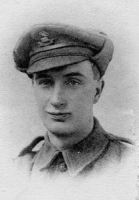

Lieut Edward Stanley Ashcroft
1883 - 1918
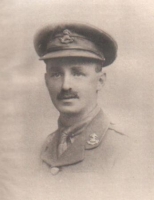
Lieut Edward Stanley Ashcroft

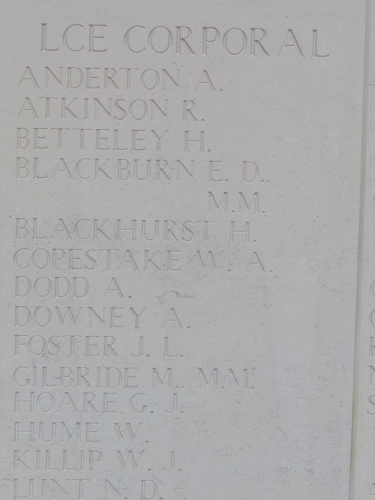
Lance Corporal Albert Dodd


  • Age: 25
  • From: Liverpool
  • Regiment: 12 KLR
  • Died on Friday 30th November 1917
  • Commemorated at: Cambrai Memorial
    Panel Ref: Panel 4
Albert was born in Liverpool in the last quarter of 1892, the son of George Dodd and his wife Sophia (née Brown).  George and Sophia were both born in Liverpool, married in 1889 and had four children. Albert had an older sister Emily, and younger siblings Frank and May. 
 
In 1901 the family, with three children, is living at 57 Tintern Street, Kirkdale.  His father George, 35, is a sawyer, his mother Sophia is 32, Emily is 10, Albert 8, and Frank 5.
 
By 1911 they have moved to 9 Penuel Road, Walton. His father is 45, a saw maker in a saw mill, his mother is 42, Emily is 20, no occupation, Albert is 18, a case packing maker (timber) for an engineer’s, Frank is 16, a grocer’s shop assistant, and May is 7.
 
Albert enlisted in Liverpool as Private 24284, 19th Bn (medal roll shows 18th Bn) King’s (Liverpool) Regiment. Based on the amount of the War Gratuity, he served about 27 months, enlisting in about August 1915.  He was promoted to Lance Corporal and at some point was transferred to the 12th Bn K.L.R.  
 
By the end of November 1917 the 12th battalion was in the front line at St. Waast, northeast of Cambrai near the Belgian border.  The German surprise counter attack began on 30th November.  The battalion War Diary for 30th November - 2nd December 1917 records:

“About 7:30 a.m. the enemy attacked in masses under cover of a heavy artillery barrage and heavy machine gun fire from a large number of low-flying aeroplanes.  These aeroplanes also dropped a number of H.E, and smoke bombs.  The enemy were seen to have penetrated the line on our Right, so that it became necessary for the Battn to retire in order to avoid being cut off.  Owing to the heavy M.G. fire from hostile planes on the Battery Positions, the “S.O.S.” signal was not responded to. A considerable amount of confusion was inevitable.  Parties were organised from time to time to defend positions but they were continually outflanked.   The remnants of the Bn were attached to other units of the 61st Bde as nearly all the officers had become casualties.”  The War Diary records Casualties for 30th November - 2nd December 1917: 
Officers  9 Missing, 2 Wounded
O.R.  229 Missing, 55 Wounded
 
Albert was one of those Missing in action. His name appeared in the list of Missing published in the Liverpool Daily Post on 18th January 1918.
 
His sister Emily made enquiries with the International Red Cross, who coordinated information on prisoners of war.  ICRC records reveal that two negative responses were sent, the first on 30/1/1918 and the second on 6/5/1918.  A notation dated 11/7/1918 on his ICRC card records, Pte. A. Harrison, at Serre,

“I was informed by a comrade that L/Cpl A. Dodd was killed in action, this was official and seen by said comrade.” 
 
His family apparently received definite news of his fate after more than 10 months of anguish, and placed a notice in the Liverpool Echo on 9th October 1918:

“Missing since November 30, 1917, now officially presumed killed on that date, aged 25 years, Lance Corporal Albert Dodd, 24284 K.L.R. (late Pals), eldest son of George and Sophia Dodd, 13, Victoria Drive, Orrell Park.  (Deeply regretted by Parents and Sisters, also brother Frank (en route for Russia).”
 
A letter from his sister Emily was published in the Liverpool Echo a year after Albert went missing, on 22nd November 1918, under the heading,

‘A Sister’s Search’:

 We have received the following letter from Miss E. Dodd, 13, Victoria Drive, Orrell Park, Liverpool:-
 
“Whilst inquiring for information re Lance Corporal Albert Dodd, 24284, 12th King’s Liverpool Regiment, who has been missing since November 30, 1917, I have received news from the Queen Victoria Jubilee Fund Association, Geneva, Switzerland, that Private C. L. Dodd, K.L.R., is, according to a notification received from the Central Committee of the German Red Cross Association in Berlin, a prisoner of war in the German lines of communication. I have written to Officer Records, Preston, who cannot trace on particulars given.  Can anyone advise me how to get in touch with Private C. L. Dodd’s relatives?  Also how I may obtain definite information about my brother? I may mention that I have communicated with the Queen Victoria Jubilee Fund Association informing them of the difference in the initials of the names.”
 
Albert’s death was presumed for official purposes, to have occurred on or since 30th November 1917.  His body was never recovered from the battlefield, and he is commemorated on the Cambrai Memorial, Louverval, Nord.

The CAMBRAI MEMORIAL commemorates more than 7,000 servicemen of the United Kingdom and South Africa who died in the Battle of Cambrai in November and December 1917 and whose graves are not known.

Sir Douglas Haig described the object of the Cambrai operations as the gaining of a 'local success by a sudden attack at a point where the enemy did not expect it' and to some extent they succeeded. The proposed method of assault was new, with no preliminary artillery bombardment. Instead, tanks would be used to break through the German wire, with the infantry following under the cover of smoke barrages.

The attack began early in the morning of 20 November 1917 and initial advances were remarkable. However, by 22 November, a halt was called for rest and reorganisation, allowing the Germans to reinforce. From 23 to 28 November, the fighting was concentrated almost entirely around Bourlon Wood and by 29 November, it was clear that the Germans were ready for a major counter attack. During the fierce fighting of the next five days, much of the ground gained in the initial days of the attack was lost.

For the Allies, the results of the battle were ultimately disappointing but valuable lessons were learnt about new strategies and tactical approaches to fighting. The Germans had also discovered that their fixed lines of defence, no matter how well prepared, were vulnerable.

The Cambrai Memorial was designed by Harold Chalton Bradshaw with sculpture by Charles S. Jagger. It was unveiled by Lieut-General Sir Louis Vaughan on 4 August 1930.

The memorial stands on a terrace at one end of LOUVERVAL MILITARY CEMETERY. The chateau at Louverval, was taken by the 56th Australian Infantry Battalion at dawn on 2 April 1917. The hamlet stayed in Allied hands until the 51st (Highland) Division was driven from it on 21 March 1918 during the great German advance, and it was retaken in the following September.

Parts of Rows B and C of the cemetery were made between April and December 1917 and in 1927, graves were brought in from Louverval Chateau Cemetery, which had been begun by German troops in March 1918 and used by Commonwealth forces in September and October 1918.

The cemetery now contains 124 First World War burials.

His mother Sophia, at 13 Victoria Drive, Orrell Park, Liverpool, received Albert’s Army effects, including a War Gratuity of £13-10s and a pension of 10/- a week.  His brother Frank survived the war.  His parents later moved to 6 Sandyville Grove, Walton, where his father died aged 61 in 1926.  Sophia died in 1934, aged 65.
 
Albert is commemorated on Liverpool’s Hall of Remembrance, Panel 4 (19th Bn)

We currently have no further information on Albert Dodd. If you have or know someone who may be able to add to the history of this soldier, please contact us.

Killed On This Day.

(108 Years this day)
Sunday 16th June 1918.
Pte 57615 Fred William Preddy
23 years old

(105 Years this day)
Thursday 16th June 1921.
Captain Leonard George Duncan
43 years old