
1885 - 1916
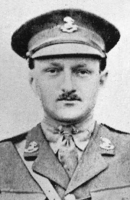
CPL David Wallace Crawford
1887 - 1916
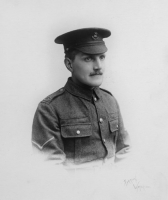
Lce-Corpl John Joseph Nickle
1894 - 1916
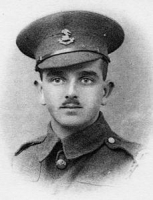
Pte 17911 Morton Neill
1897 - 1916
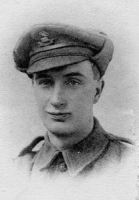
Lieut Edward Stanley Ashcroft
1883 - 1918
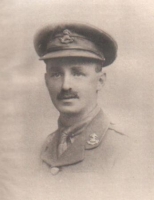
Serjeant Alfred Folkard
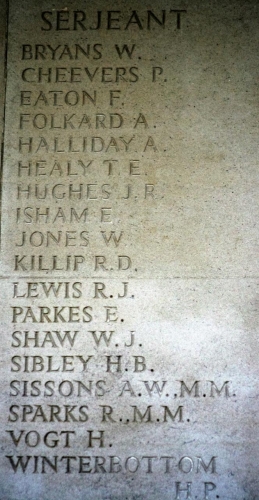
- Age: 31
- From: Gibraltar
- Regiment: 13th Kings
- Died on Thursday 28th March 1918
- Commemorated at: Arras Memorial
Panel Ref: Bay 3
Alfred Folkhard was born in Gibraltar in 1887 the son of Alfred George Folkard and Martha Publio (née Rees), who married in Chester in 1885. His father was born in 1859 in Hackney, and his mother in Malta in about 1863. Alfred senior had enlisted in the Army in 1877 at 18 (occupation clerk, religion Baptist). He served with the Army Service Corps in Malta 1878-81, Gibraltar 1881-82, Egypt 1882, Home 82-85 (Chester 84-85), and again in Gibraltar 1885-90 (where four children were born), Home 90-96, (Mullingar 1891-92 where youngest son Charles was born), Dublin 93-95, and Limerick 95-96. He was discharged in 1896 at the age of 37, rank Staff Sgt. Major, Chief Clerk, Commissariat & Transport Corps. (His Egypt Medal and Khedive’s Star were put up for sale at auction in Dublin in 2013, asking price €260, but withdrawn).
His parents had five children. Alfred had an older sister Gertrude Mabel, born in 1886, and younger siblings Margaret Augusta 1888, Edith May 1890, all born in Gibraltar. Their youngest child, Charles Ernest, was born in 1892 in Mullingar, Ireland (home of Wellington Barracks, now Columb Barracks).
Owing to the scarcity of water in Gibraltar, the military population was, at all times, placed on a water allowance just as if the garrison were in a state of siege. According to military protocol, the amount of potable water was rationed according to rank, age, and gender. Commanding officers received seven gallons of water per day; NCOs and the rank and file were allotted two-and-a-half gallons per day. As members of the regiment, military wives were also rationed two-and-a-half gallons per day, and military children received one gallon per day.
In 1901 they are found in Huddersfield, Yorkshire, at 21 St. Stephen’s Terrace, Lockwood, with five children. His father, 41, is an Army pensioner, his mother is 36, Alfred is 14, working as a messenger lad.
By 1911 they are living at 498 Stretford Road, Lower Edmonton, Middlesex. His father is 51, an Army pensioner, his mother is 48. Gertrude, 24, is metallic filament lamp capper, out of work. Alfred is 24, a tomato grower/nurseryman. Edith, 20, also works in metallic filament lamp manufacturing, and Charles is 19, working for a racket (illegible) manufacturer.
His mother died in the fourth quarter of 1911, aged 49 and his father a few months later, aged 53. His brother Charles died in the summer of 1914, at the age of 22.
At the time of the war he was living in Birkenhead and enlisted in Liverpool joining the 19th Battalion of the King's Liverpool Regiment as Private 24241.
Formed on 07th September 1914 the 19th Battalion trained locally at Sefton Park and remained living at home or in rented accommodation until November 1914. They then moved to the hutted accommodation at Lord Derby’s estate at Knowsley Hall. On 30th April 1915 the 19th Battalion alongside the other three Pals battalions left Liverpool via Prescot Station for further training at Belton Park, Grantham. They remained here until September 1915 when they reached Larkhill Camp on Salisbury Plain.
Alfred shipped to France with his battalion, disembarking at Boulogne on 07th November 1915.
He was subsequently promoted and was serving as Serjeant in the 13th Battalion of the King's Liverpool Regiment when he was declared misisng on 28th March 1918 during the German Spring offensive.
The Red Cross records show that his sister Rita Fyfe of 1 Osborne Road, Enfield had requested information concerning her brother who was attached to C Company, 10 Platoon as a Lewis Gunner.
By March 1918 the 13th Battalion was in Brigade Reserve south of Arras which had been moved close to the line in view of an expected hostile attack. The battalion War Diary gives us an insight into the ferocity of the German attack which launched the start of Operation Michael, the German Spring Offensive -
At dawn on the 21st March the enemy suddenly put down an intense barrage of H.E. and gas shell on the whole of the Brigade Sector. The bombardment of the whole of the Battalion area was intense, many gas shells were used and box respirators were worn for several hours. But on the Brigade Front the attack had been held, and the Battalion was not called upon to move. The next day the onslaught continued, late in the afternoon the enemy had reached the wire, the wide belts of wire which the Germans had erected to protect the Hindenburg Line, and on which he was now making a frontal attack. The 13th were ordered to cover the withdrawal.
At 5 a.m. on the 24th the battalion marched to its battle positions in the Green Line and that afternoon relieved the Royal Scots in the 3rd System near Henin.
On the 27th their positions were heavily shelled throughout the day.
“On 28th March at 4:30 a.m. the enemy put down an intense barrage on the whole of our sector. The Trench Mortar barrage on the front line was more intense than anything previously experienced. The Reserve Line was barraged with field guns and heavies. Under cover of this barrage the enemy launched a terrific attack with masses of troops. In spite of the intensity of the bombardment the front line stood firm and poured a devastating fire into the enemy whose attack was beaten off with colossal casualties to the attackers.
“The value of this steadfastness against tremendous odds cannot estimated - it gave the enemy his first check at a point where he was to be subsequently checked throughout the day. The enemy came back again in a second attack with even greater numbers. The Battalion on our right were pressed back and the eemy poured in behind 'C' and 'D' companies from the right flank. What happened on the left flank is not known. All that is known is that these two companies, attacked on all sides, mounted the parapet and fought to a finish on the ground on which they stood. Under cover of the barrage the enemy came on up the hill to the reserve lines. Owing to the nature of the ground, he could not be observed along most of the battalion front until nearly on our wire. The barrage lifted, and in dense waves the Germans swept on to our lines. It was the beginning of a fierce battle which lasted until 2 p.m.
“The courage, coolness and endurance of the Garrison were beyond praise. Every rifle and Lewis Gun brought a tremendous volume of fire to bear on the approaching masses. In spite of his losses the enemy continued to push on until the thin line remaining could go no further, and turned down the slope. Our men mounted the parapet to keep him under fire as long as they could keep him in sight. The first attack on the first line had been beaten off, and our line was everywhere intact.
“All communication by wire was lost from the commencement of the action. Communication was however kept by lamp with the Brigade, and by this means some field guns were brought to cover our front on the Eastern side of the Henin Road.
“The enemy now resumed his barrage on our position by firing green lights. An intense barrage came down for 10 or 15 minutes. As soon as it lifted the enemy immediately came on to another attack. This also was repulsed with heavy loss to the enemy. Our flanks were still intact, but it was known that further to the left the enemy was making progress and our Left flank was becoming exposed. Twice again the enemy fell back, each time bringing down the barrage on our position with green lights, and pushing on his attack as soon as it lifted. About mid-day the enemy's fourth attack penetrated on our right. A block was immediately made and maintained about 150 yards fom the Road .
“From mid-day onwards only about 500 or 600 yards of the reserve line remained in our hands, the troops on both flanks having fallen back some hundreds of yards. It was evident that when the next hostile attack came the position would inevitably be surrounded and would hold out no longer. However, it was decided to hold on, though the Brigade message informed us that no reinforcements were available. ... Withdrawal to support of the 4th Royal Fusiliers in the Green Line was then decided upon and orders were issued for an immediate withdrawal. It commenced at 3:30 p.m., the movement from the front line being covered by small posts and blocks and the defensive flank on the right remaining in position until all the garrison of the Reserve Line had moved off to the S.W. of Neuville Vitasse Road by the Sugar Factory. The enemy moving forward for another attack severely harassed the withdrawal, and it was only by great gallantry and initiative by individuals that the enemy was warded off until the line was clear.”
The battalion lost 82 men that day, the vast majority of whom, 74, have no known grave and are commemorated on the Arras Memorial to the Missing.
Alfred was eventually declared as killed in action on 28th March 1918, aged 31.
His body was not recovered or was subsequently lost and his name is on of those recorded on the Arras Memorial in France.
The ARRAS MEMORIAL commemorates almost 35,000 servicemen from the United Kingdom, South Africa and New Zealand who died in the Arras sector between the spring of 1916 and 7 August 1918, the eve of the Advance to Victory, and have no known grave. The most conspicuous events of this period were the Arras offensive of April-May 1917, and the German attack in the spring of 1918. Canadian and Australian servicemen killed in these operations are commemorated by memorials at Vimy and Villers-Bretonneux. A separate memorial remembers those killed in the Battle of Cambrai in 1917. Both cemetery and memorial were designed by Sir Edwin Lutyens, with sculpture by Sir William Reid Dick. The memorial was unveiled by Lord Trenchard, Marshal of the Royal Air Force on the 31 July 1932 (originally it had been scheduled for 15 May, but due to the sudden death of French President Doumer, as a mark of respect, the ceremony was postponed until July).
Alfred’s name appeared in the list of Missing in the Weekly Casualty List on 4th June 1918:
Folkard 24241 A/Sjt. A. (London, N.).
His death was later presumed, for official purposes, as having occurred on or since 28th March 1918.
His Army effects and a War Gratuity of £22 went to his sister Rita Fyfe.
No pension card has been found, indicating that Alfred had no dependents.
Sadly, Alfred had not been found on any memorial.
We currently have no further information on Alfred Folkard. If you have or know someone who may be able to add to the history of this soldier, please contact us.
89th Brigade On This Day.
110 Years Ago.The Battle of the Transloy Ridges begins. more....
Killed On This Day.
(110 Years this day)Sunday 15th October 1916.
Pte 30280 James Patrick Doyle
25 years old
(110 Years this day)
Sunday 15th October 1916.
Pte 34608 Thomas Foster
19 years old
(110 Years this day)
Sunday 15th October 1916.
Pte 53107 Joseph Green
32 years old
(110 Years this day)
Sunday 15th October 1916.
Pte 11282 Stephen Hynes
21 years old
(110 Years this day)
Sunday 15th October 1916.
Pte 32717 Evan Lee
25 years old
(110 Years this day)
Sunday 15th October 1916.
Pte 34271 James Vickers
21 years old
(108 Years this day)
Tuesday 15th October 1918.
Cpl 15764 Alan Douglas Ellison
30 years old