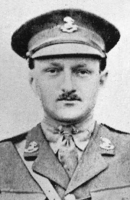
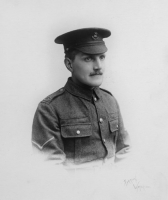
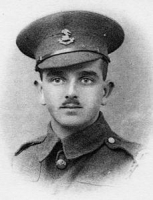
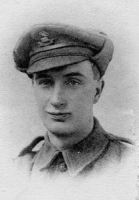
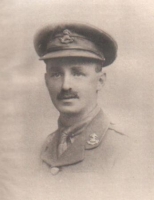
John Albert (known as Jack) was born in Willaston, Cheshire (between Nantwich and Crewe), the son of Peter Cunniff and his wife Hannah (née Allcock). His birth was registered in the March quarter of 1895 at Nantwich, but his school record gives his birthdate as 19th January 1894. However, this may have been an error, as his age on census and employment records supports his being born in early 1895. The family name appears as Cunniff on many records. Jack enlisted as Cunniffe.
His father, born in Heywood, Lancashire, and his mother, in Willaston, Cheshire, married in 1890 and had ten children, one of whom died young. John had older siblings Emily (born Allcock) and Charles, and younger siblings Ann, Hannah, Harold, Peter, Emily, and Ernest.
In 1901 the family (listed as Cunliff), is living at 69 Wistaston Road, Willaston. His father, is aged 34, and is a railway coach cleaner, his mother, Hannah, is aged 31, and they have five children, all born Willaston; Emily, is aged 11, Charles, is aged 9, John is aged 6, Ann Jane, is aged 3 and Hannah, is aged 1.
His eldest sister Emily died in 1903, aged 13.
The family had moved to Crewe by 1906, when John was enrolled in Edleston Road School, the family living at 3 Stewart Street.
By 1911 they are found at 313 Alton Street West, with eight children aged between 2-20. His father, is aged 45, and is a railway labourer (carriage dept.), and his mother is aged 42. They advised that they have been married for 21 years, they have had 10 children, 8 of whom have survived. There are nine children in the household; Charles, is aged 20, and is a carriage painter (loco works), John is aged 16, and is a news boy. The younger children are at school: Ann, is aged 14, Hannah, is aged 11, Harold, is aged 8, Peter is aged 6, and Emily, is aged 4. Ernest, is aged 2. The census form is signed by his father as Cunniff.
Before enlisting, Jack worked for Jackson’s Stores Ltd., a large house furnishings company, in Victoria Street, Crewe, according to newspaper reports. However, Railway Employment records show John Albert Cunniff, aged 19, born 08th February 1895, engaged the week ending 16th July 1914 as a boy labourer at the rate of 18/- a week, with references from Mr. Seed, draper, Jackson’s Ltd., Victoria Street, having been employed there for three years.
He enlisted in Liverpool joining the 17th Battalion of The King’s Liverpool Regiment as Private No 26152. Based on the amount of the War Gratuity, and his regimental number, he enlisted in about April 1915.
Jack shipped to France with his battalion, disembarking at Boulogne on the 07th November 1915.
On the 29th April 1916 Jack was with A Company, K.L.R. when he was attached to the 89th Bde. M.G.C. He fully transferred as Pte 22804 to the Machine Gun Corps on the 27th July 1916. The 214th Coy was formed in December 1916, and joined the 58th Division in France on 25th March 1917. The newspaper reports of his death refer to him as being with the K.L.R., with no mention of the M.G.C.
Jack was killed in action on the 20
th September 1917 whilst serving with the Machine Gun Corps as a Lance Corporal with the service number 22804. CWGC gives his age, supplied by the family, as 24, but based on census records, he would have been 22 years old.
He has no known grave and is commemorated on the Tyne Cot Memorial in Belgium.
Those United Kingdom and New Zealand servicemen who died after August 16th 1917 are named on the Tyne Cot Memorial, a site which marks the furthest point reached by Commonwealth forces in Belgium until nearly the end of the war.
The Tyne Cot Memorial now bears the names of almost 35,000 officers and men whose graves are not known. The memorial, designed by Sir Herbert Baker with sculpture by Joseph Armitage and F.V. Blundstone, was unveiled by Sir Gilbert Dyett on 20 June 1927.
The memorial forms the north-eastern boundary of Tyne Cot Cemetery, which was established around a captured German blockhouse or pill-box used as an advanced dressing station.
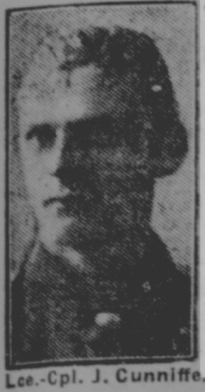
His death was reported in the Nantwich Guardian on 28th September 1917, alongside his photograph;
KILLED.
LANCE-CORPORAL J. CUNNIFFE.
“Mr. and Mrs. Cunniffe, 234 Alton Street, Crewe, received information on Thursday that their son, Lance-Corporal Jack Cunniffe, of the King’s (Liverpool Regiment), had been killed in action. He was wounded some time ago. He enlisted about two years ago and before the war was employed at Jackson’s Stores, Crewe. Lance-Corporal Cunniffe, who was well-known in Crewe, will be greatly missed among his wide circle of friends.”
More information was published a week later, on 5th October 1917:
“Mr. and Mrs. Cunniffe, of 230 Alton Street, Crewe, have received the following letters in reference to their son, Lance-Corporal Jack Cunniffe, who was killed in action:-
‘It is with the deepest regret that I have to inform you that your son was killed in action with the company on 20th September. He was on duty with his gun and was killed instantaneously. … I can only say how much every officer and man who knew him liked and respected him. He always did his duty, no matter what it was, and always showed the greatest courage under most trying and dangerous circumstances. I have known him for a long time, and always had the greatest admiration for his cheerfulness and devotion to duty. Yours sincerely, Lieutenant R. Sommerville.’
Lance-Corporal Durant writes ‘It is my painful duty as a comrade of your dear son, Jack, to inform you that he was killed by an enemy shell on 20th September while doing his duty for his King and his country. It will be no doubt a bit of comfort to you to know that he died instantaneously. My section and myself wish to bear with you the loss of such a good lad, and hope that you will bear your trouble bravely. He was a very good soldier and was liked and respected by all who knew him. It is very hard to lose a son, but he died that you people at home might live, and he, like many other lads, died as they lived, true to the last. Hoping that you will accept the sympathy of the section.’
Lance-Corporal Cunniffe was in the King's Liverpool Regiment, and was previously wounded. Before enlistment he was employed at Jackson’s Stores, Crewe.”
Jack earned his three medals. His 1914-1915 Star was mistakenly issued in the name Cunliffe, but was accepted, according to the medal roll.
His father Peter received Jack’s Army effects, Army Pay £4 6s 9d and a War Gratuity of £10-10s. The amount of the pension awarded is not clear from the pension cards, in the name of his parents at 335 Alton Street, and 236 Alton Street.
His sister Ann later had a son she called Jack.
On the 1921 Census at 230 Alton Street West, his father, is aged 56, and is a railway coach cleaner, his mother is aged 51, with Jane, aged 23, Harold, aged 19, a clerk, Peter, aged 16, a fitter, Emily aged 13, and Ernest aged 10.
In 1939 his parents were still living in Alton Street, at no. 208. His father, is aged 73, and is a retired carriage cleaner, and his mother is aged 69.
His father died in 1947 aged 81, and his mother lived until 1963, aged 93.
His mother's death was reported in the Crewe Chronicle on Saturday 04th January 1964;
MRS. H. CUNNIFFE
The funeral of Mrs. Hannah Cunniffe, aged 93, of 12, Darlington-avenue, Crewe, took place on Friday last week. The interment was in Crewe Cemetery after a service in St. Barnabas's Church, Crewe, conducted by the Rev. G. Niblock. Mrs. Cunniffe, who died in hospital on the previous Sunday, was widow of Mr. Peter Cunniffe, a railway carriage worker, who died in 1947. She leaves four sons and two daughters. The mourners were Mr. H. Cunniffe, Mr. P. Cunniffe, Mr. E. Cunniffe (sons): Mr C. Cunniffe son) was unable to attend through illness: Mr. H. Milward, Mr. J. Cruar (sons-in-law), Mr. K. Cunniffe, Mr. J. Milward and Mr F. Milward (grandsons).
John is commemorated on the following memorials -
Crewe Mechanics Institution (Municipal Buildings, Earle Street, Crewe)
Crewe War Memorial (as Cunniff)