
1885 - 1916
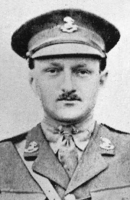
CPL David Wallace Crawford
1887 - 1916
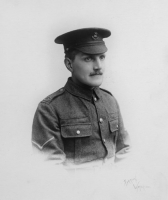
Lce-Corpl John Joseph Nickle
1894 - 1916
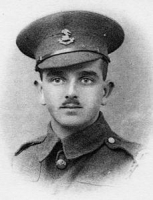
Pte 17911 Morton Neill
1897 - 1916
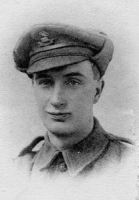
Lieut Edward Stanley Ashcroft
1883 - 1918
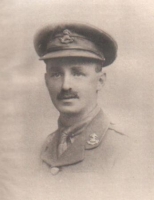
Lt. Col. Edward Henry Trotter (DSO)

- Age: 44
- From: London
- Regiment: The King's (Liverpool Regiment) 18th Btn
- K.I.A Saturday 8th July 1916
- Commemorated at: Peronne Rd Cem Maricourt
Panel Ref: IV.H.28
Lieutenant Colonel Edward Henry Trotter DSO was the most senior officer in the Pal’s battalion to lose his life in the First World War. He was born into an aristocratic family steeped in military service, on 1st December 1872 in Kensington, London. His father, Henry Trotter, was an officer in the Grenadier Guards, later with the rank of Major-General, who would become the 11th Baron of Morton Hall, Midlothian on the death of Edward’s grandfather in 1874. His parents married on the 24th May 1866 at St Paul’s, Knightsbridge.
The Belfast Newsletter 26th May 1866
Trotter and Gifford - May 24 at St Paul's, Knightsbridge, London by the Hon. and Rev. John Gifford, assisted by Hon. and Rev. Mr Liddell Henry Trotter Esq., Grenadier Guards, yr. of Molton Hall, to Hon. Miss Eva Gifford.
Edward was baptised on the 21st December 1872 at St Paul, Wilton Place, his father a Captain in the Grenadier Guards, 9 Ovington Gardens.
Edward’s brothers would all later serve in the military; Colonel Algernon Richard Trotter DSO, MVO, (12th Baron in 1905), Brigadier General Frederic Trotter DSO, and Captain Reginald Baird Trotter.
By 1881 Sir Henry, now a Colonel, was based in Cirencester living in Golden Farm Lodge with his wife Eva and young family. Father Henry is aged 39, born in Liberton, Edinburgh, mother Eva is aged 35, born in Elton, nr Ludlow, at school are Meta 13, Edward 8 and Reginald 7. They have a multitude of servants.
The 1891 Census they were present at The King's Head Hotel, 9 Dyer St, Cirencester. Two years later, Edward Trotter, now nineteen, moved from the militia to the Grenadier Guards, and first saw action in the Nile Expedition of 1898, being present at the Battle of Khartoum, and receiving the British and Egyptian campaign medals. He was promoted captain in 1900, and served throughout the South African War with the City of London Imperial Volunteers, firstly as a staff captain, and then with a unit of mounted infantry. As a result of his service in the war, he was awarded the Distinguished Service Order, he was Mentioned in Despatches, and received the Queen's and King's South Africa Medals. He was granted his majority in 1905. During the conflict, the family had relocated to London, residing in 22 Cadogan Square, Chelsea, a typical ‘upstairs-downstairs’ household with twelve servants below stairs.
His father died in 1905.
Edinburgh Evening News - Monday 17 July 1905
DEATH OF MAJOR-GENERAL TROTTER.
The death occurred yesterday at Mortonhall, of Major - General Sir Henry Trotter, G.C.V.O. Sir Henry for some months past had not been in perfect health, and a few days ago he was seized with severe internal illness. Deceased was the eldest son of the late Mr Richard Trotter, of Mortonhall, and was born in 1844. He was educated at Harrow, and in 1862 he obtained his commission the Grenadier Guards, being, understood, the last officer who bought a commission in that regiment. In four years, and when he was only 22 years old, was promoted the command his company, and in 1871 he was made Lieut.- Colonel. He was promoted Major-General in 1895, and two years later became Commanding Officer of the Home District, holding this position till three years ago. The deceased officer was never on active service. When the Guards went to Egypt 1882 he was not selected, and long before the Boer War had severed his official connection with his regiment. It was understood, however, that but for an accident which he met with in London shortly before the outbreak of hostilities would have been given the command which went to General Gatacre. As General Commanding the Home District he did a lot in connection with the mobilisation and despatch of troops, and in recognition of this service his Majesty conferred the K.C.V.O. on him in 1901, and the G.C.V.O. in 1902. In private life General Trotter was an ardent lover of sport, riding regularly to hounds, while was also captain of Mortonhall Golf Club. He was a good shot, and an enthusiastic angler. He took a great interest in military charities. He married the Hon. Eva Gifford, daughter of the second Baron of Old Park, Chichester, 1866, and had a family of four sons, all of whom are in the Army, and one daughter. He is succeeded his eldest son Algernon Richard Trotter, M.V.0., who was aide-decamp to General Buller South Africa.
By 1911 Edward, now a Major, had moved to an officer’s military townhouse at 12 Sloane Street, London with his brother Major Gerald Frederic Trotter, (also in the Grenadier Guards), each accompanied by a Grenadier Guard’s batman - Private Arthur Sidney Bates aged 30 and Private Henry Bale, 27, plus their housemaids. In September 1914, he was given command of the 18th Battalion, no doubt at the suggestion of Lord Derby's brother, then Lieutenant-Colonel F C Stanley, a serving officer in the 3rd Battalion, The Grenadier Guards. The battalion was initially located at Hooton racecourse, where they were supervised by NCOs from the Grenadier Guards. The new commanding officer was enthusiastic about physical exercise. In spite of a weak knee as a result of a hunting accident, Trotter would often take part in his battalion's daily exercises. The 18th's prowess in inter-battalion competitions earned them the nickname ‘Trotter's Greyhounds’. After landing at Boulogne, France in November 1915, Trotter's battalion was moved to the Somme area. On 1 July 1916, on the first day of the Somme offensive, the 18th King's advanced with their division towards Montauban. Located on the left flank of the French, and to the south of where the British Army sustained most of its casualties on the first day, the 30th Division began its advance at 7.30am. An effective French bombardment ensured the advance encountered mostly limited opposition. The 18th King's, however, was subjected to relentless fire from German positions during their advance on the Glatz Redoubt. The division's objectives were nevertheless achieved, one of the few successes of 1 July. Trotter estimated that the 18th had suffered about 500 casualties on the first-day. Now reduced to minimal strength, the 18th was withdrawn from the front and converted to a carrier battalion. When ordered to move forward on 8 July, Trotter decided to oversee the movement personally and arrived before the battalion. The troop movements prompted the Germans to bombard the area. A shell landed in the entrance to brigade headquarters, killing Lieutenant Colonel Trotter, a lieutenant, two other ranks, and mortally wounding Lieutenant Colonel William Smith of the 18th Manchester’s.
Extracts from the war diary of the 18th Battalion, The King’s Liverpool Regiment, reveals more;
Oxford Copse/Train Alley/Briqueterie/Trones Wood 7/7/16 Moved to assembly trenches between Oxford and Cambridge Copse and bivouacked there. Battalion, about 350 strong, detailed as carrying parties for Brigade. 8/7/16 In the afternoon the Battalion was moved up to Train Alley Brigade HQ - Lt Col EH Trotter with the Adjutant and two orderlies moved up in advance and reported to Brigade HQ. The Colonel while seeing his Battalion up to their positions was to the great sorrow of all killed by a shell at about 5:30pm in Train Alley. Officer Casualties Killed Lt-Col EH Trotter DSO (Major Grenadier Guards), 2nd Lt NAS Barnard. Wounded 2nd Lt DM Griffin. 9/7/16 At noon Battalion moved to assembly trenches at Oxford Copse about 322 strong. At 7:30pm moved to bivouac at Trigger Wood. New draft of 154 other ranks arrived. An account of the part of the Battalion in the fighting:-
On 7 July 1916 the Battalion left the Bois des Tailles at 6:30pm and marched to Cambridge and Oxford Copse, taking its position there in the assembly trenches for the night of 7/8 July 1916. The Battalion had been previously detailed to provide the necessary carrying parties for the Brigade. The strength of the Battalion was 16 officers and 350 other ranks. At 2.15pm on the 8th No 2 Company under Major Bowden was ordered to take water from the southern end of the Talus Boise and to report to the Staff Captain at the Briqueterie. On reporting he was ordered to carry SAA, grenades, rockets and water to A Company 2nd Wilts Regt in Hairpin Trench near Maltzhorn Farm and return to report to the Staff Captain. Major Bowden reported to the Staff Captain on his return at 9.30pm and was ordered to take command of the Battalion owing to the Commanding Officer having been killed, and his Company was sent under 2nd Lt DM Griffin to garrison Chimney Trench.
At 3pm on the 8th, the remaining companies moved up Train Alley carrying water and what remained of the RE stores. The Commanding Officer had moved up to Train Alley ahead of these three Companies and was killed by a shell at about 5.30pm in Train Alley Trench. The three Companies had arrived in Train Alley shortly before the Commanding Officer was killed. Under orders from the Brigadier at 6pm Captain G Ravenscroft Commanding No 3 Company was sent with his Company carrying water to report to Col Hill at the Briqueterie and thence ordered by him to carry the water to Trones Wood where he arrived at about 8pm. While handing over the water the Germans counter attacked and No 3 Company manned the trenches with the 2nd Wilts Regt and 19th Manchester’s. After this attack being repelled, in accordance with the previous request of the Adjutant of the 2nd Wilts two Lewis Gun teams were left in the trench under Sgt H Mann where they remained until 5.30am on 9 July, being then dismissed by Captain McNaman. The remainder of the Company which had been split up into small parties, returned to Train Alley where they reported at a point 1am on 9th to the Brigadier.
At 8:30pm on the 8th, Nos 1 and 4 Companies under the command of Captain Stoddart were sent to the Briqueterie to report to Col Hill, commanding 19th Manchester’s. He ordered the two companies to man the sunken road and prepare fire positions in case of a counter attack. Just before dawn Major Bowden obtained permission from the Brigadier to move his Company, which was suffering heavy casualties from Chimney Trench to Nord Alley. At 6 am on the 9th No 1 Company collected bombs, sand bags and SAA and carried them to Trones Wood. No 4 Company also carried bombs, sand bags and SAA to Hairpin Trench. The Battalion was relieved by a Battalion of the 90th Brigade and returned to Oxford Copse arriving there at midday. The total casualties of the Battalion were:-
2 officers and 4 other ranks killed; 1 officer and 20 other ranks wounded and 1 other rank missing.
From the very first day of his command, Trotter endeared himself to his men with his professional but friendly manner, and his total dedication to the welfare of his Battalion. Many tributes to deceased officers of the Great War state that they were worshipped by their men, but in Trotter's case, it was undoubtedly true. It was not unusual, for instance, during training in England or on active service in France, for him to help out a weary soldier by carrying his pack or rifle, and he was always able to bring out the best in his men, whatever the circumstances. He was very upset, though very proud, after the Battalion's losses in the successful attack on the Glatz Redoubt south of Montauban on 1 July 1916, the first day of the Battle of the Somme. At first, hardly able to believe the enormity of what had happened, he later walked over the battlefield, encouraging the wounded who still lay there, and noting the positions of the dead.
Just a week later and he too, was dead. On the 8 July, the Battalion was ordered up to Train Alley, to provide carrying parties for the rest of the Brigade. This was because there were insufficient numbers left after the losses of 1 July, for the Battalion to man the line. Trotter went ahead of the unit, and reached the Headquarters of the 21st Brigade, in Train Alley. At about 5.30 pm the Germans shelled the trench, and a shell landed on the position killing Trotter, and Second-Lieutenant N A S Barnard. The Commanding Officer of the 18th Battalion, The Manchester Regiment, Lieutenant-Colonel W A Smith, formerly Second in Command of the 20th Battalion, The King's (Liverpool Regiment) was fatally wounded by the same shell. Trotter was aged forty-three. It is safe to say that as the news of his death spread around the Battalion, nearly all the men were in tears. Brigadier-General F C Stanley, then in command of the 89th Brigade, best summed this up when he wrote of him,
'He left a blank that could never be filled, and somehow one would never like it to be filled. His was a unique personality. His discipline was one which sprang from affection which all his men had for him. They all, from their love of him, simply could not do anything but try to please him. His ideals were of the highest. He expected the best out of everyone and by his setting the example himself, he always got .it. He was more like a father to each individual in his Battalion than anything else, and his love for them was unbounded'.
He is buried in Peronne Road Cemetery, Maricourt, in Plot IV, Row H, Grave 28, not far from where he was killed, and amongst those of his men who also fell on the Somme.
Maricourt was, at the beginning of the Battles of the Somme 1916, the point of junction of the British and French forces, and within a very short distance of the front line; it was lost in the German advance of March 1918, and recaptured at the end of the following August.
The Cemetery, originally known as Maricourt Military Cemetery No.3, was begun by fighting units and Field Ambulances in the Battles of the Somme 1916, and used until August 1917; a few graves were added later in the War, and at the Armistice it consisted of 175 graves which now form almost the whole of Plot I. It was completed after the Armistice by the concentration of graves from the battlefields in the immediate neighbourhood and from certain smaller burial grounds.
There are now 1348, 1914-18 war casualties commemorated in this site. Of these, 366 are unidentified and special memorials are erected to 26 soldiers from the United Kingdom known or believed to be buried among them. Other special memorials record the names of three soldiers from the United Kingdom, buried in other cemeteries, whose graves could not be found.
The cemetery covers an area of 3,787 square metres and is enclosed on three sides by a low red brick wall.
His younger brother, Captain Reginald Baird Trotter, of the 2nd Battalion, The Queens Own Cameron Highlanders, but attached to the 1st Battalion of the same Regiment, was killed on 9th May 1915, during the Battle of Aubers Ridge. His body was not recovered and identified after the war, and he is commemorated on the Memorial to the Missing of the 1914-1915 battles in the area, at Le Touret.
Both brothers are commemorated on Cirencester War Memorial, and also on a memorial stone in a private family graveyard at their ancestral home of Morton Hall, near Edinburgh. The stone, though now damaged and flat on the floor, once held the original wooden cross from the Colonel's grave in Maricourt. His death was reported in the Liverpool Echo on Saturday 15 July 1916;
Lieut. Colonel Edward Henry Trotter, D.S.O., Grenadier Guards, commanding a service battalion of the King's (Liverpool) Regiment, (killed in action on July 8) was born in December, 1872, and was the third son of the late Major-General Sir Henry Trotter, G.C.V.O., of Merton Hall, Midlothian. In September, 1914, he was appointed temporary Lieutenant-Colonel in command of a battalion of the Liverpool Regiment. Colonel Trotter was in the Nile Expedition of 1898, and fought in the battle of Khartoum, for which he received the Egyptian Medal, the Queen's Medal, and the Khedive's Medal with clasps. During the South African War he served with the City of London Volunteers.
A further report was contained in the Liverpool Post and Mercury on 17 July 1916;
A COMMANDER OF COMRADES FALLS
“THE FATHER OF HIS MEN”
The Comrades have lost one of their Battalion Commanders. Colonel E H Trotter D S O has fallen in the advance. While not himself a Liverpool man, the city had reason to mourn one to whom was entrusted the leadership of its soldier sons, and who trained with them and went with them into a great ordeal. He was in many respects a remarkable personality. Lord Derby showed his familiar instinct for the right man when he invited him to command a battalion. From all points it was an admirable choice.
Colonel Trotter was a fine soldier; but he was also one of those men whom to know is to honour, such is their uprightness of character and their force of example. Coming from their office desks to the strangeness of the parade ground, the comrades had before them a pattern of the chivalrous and tactful British officer who did credit to the profession of arms, and who set them from that time onwards the ideal of all that is best in the Army.
Colonel Trotter was a man of high chivalrous feeling with a devout religious spirit; devoted to duty and the soul of genial good nature. He never asked his men to do what he would not do himself. On the opening day of the advance he characteristically set the example; with no more than a dozen men in his entourage, he captured a strong redoubt from the enemy and held it for four hours until relieved. Then on the 8th July just a week after the initial attack, he met his death from an explosive shell.
No tribute of esteem could be too high for that Christian gentleman who helped to mould The Liverpool Comrades Brigade into the force that it is.
Later his probate recorded;
TROTTER Edward Henry of 126 Sloane Street Middlesex. Major Grenadier Guards and Lieutenant-Colonel King's Liverpool Regiment. Died 8 July 1916 in France. Probate London 23 December to Algernon Richard Trotter Colonel 2nd Regiment Life Guards D.S.O. M.V.O. and Walter Trelawny Boodle solicitor. Effects £25,170 0s. 3d.
As a consequence, the Liverpool Echo of 29 December 1916 reported details of his will. These again sum up the spirit of his men in the 18th Battalion – ‘Trotter's Greyhounds’:
COL. TROTTER THE GUARDS REMEMBERED IN HIS WILL
Lt Col E H Trotter DSO., Grenadier Guards, commanding a service battalion of the Liverpool Regiment who was killed in France left £25,170. The testator gives to the commanding officers of the Grenadier, Coldstream, Scots and Irish Guards as a contribution to the regimental fund £30 each in grateful remembrance of No.1 Company of the Guards Mounted Infantry in South Africa and he states: "I express the hope that the interest to be received from such legacies shall be used in giving each tailor, shoemaker and drummer boy on enlistment to provide himself with a bank book. To the Grenadier Guards the regimental cup which I won the first year I joined; in the hope that sport of all sorts will long flourish in the regiment , it having been my experience in all the wars I have been in that the best sportsman makes the best soldier, and I should like this fact to be inscribed on the cup"
He was among the names commeorate in the Liverpool Echo on the 02nd July 1917:
Lost At The Somme Battle:
To the Glorious Memory of Lieut.-Colonel E. H. Trotter, D.S.O., Captain A. de Bels Adam, Captain C. N. Brockbank, Lieut. G. M. Dawson, Lieut. B. Withy, Sec.-Lieut. N. A. Barnard, Sec.-Lieut. L. R. Davies, Sec.-Lieut. E. Fitzbrown, Sec.-Lieut. D. M. Griffin, Sec.-Lieut. G. B. Golds, Sec.-Lieut. G. A. Herdman, Sec.-Lieut. R. V. Merry, Sec.-Lieut. R. H. Tomlinson, Sec.-Lieut. T. R. Walker, and the non-commissioned officers and men the 18th (Serv.) Battalion “The King's” (Liverpool Regiment), who fell in the battle of the Somme, July, 1916.
His Army effects, army pay of £26 2s 6d and a War Gratuity of £87 went to his brother Algenon.
His mother, died aged 69, on the 06th April 1915:
Probate:-
TROTTER Hon. Dame Eva, of 126 Sloane Street, County of Middlesex, widow, died 6 April 1915 at Roehampton, County of Surrey, testate, certificate endorsed by Commissary Clerk of Edinburgh, 14 September on Probate of the Will, granted at London on 27 May 1915 to Edward Henry Trotter, the son, one of the Executors. Value of estate £13,047 18s 6d.
We currently have no further information on Edward Henry Trotter, If you have or know someone who may be able to add to the history of this soldier, please contact us.
Killed On This Day.
(110 Years this day)Thursday 17th August 1916.
Pte 15784 Charles Leslie Bibby
24 years old
(110 Years this day)
Thursday 17th August 1916.
Pte 16517 Samuel Arthur Dicks
24 years old
(109 Years this day)
Friday 17th August 1917.
Pte 49203 Arthur Hargreaves
20 years old
(109 Years this day)
Friday 17th August 1917.
Pte 33155 Francis Douglas Wilkinson
21 years old
(109 Years this day)
Friday 17th August 1917.
Lance Corporal James Bernes
28 years old
(109 Years this day)
Friday 17th August 1917.
Lieutenant Alexander Vyvyan Johnston
32 years old
(108 Years this day)
Saturday 17th August 1918.
Pte Michael O'Rorke (MM)
23 years old