
1885 - 1916
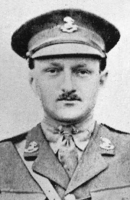
CPL David Wallace Crawford
1887 - 1916
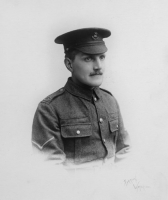
Lce-Corpl John Joseph Nickle
1894 - 1916
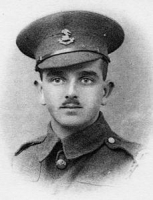
Pte 17911 Morton Neill
1897 - 1916
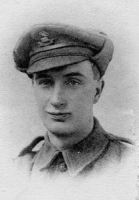
Lieut Edward Stanley Ashcroft
1883 - 1918
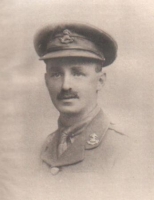
Pte 15938 Samuel Harland Thomas
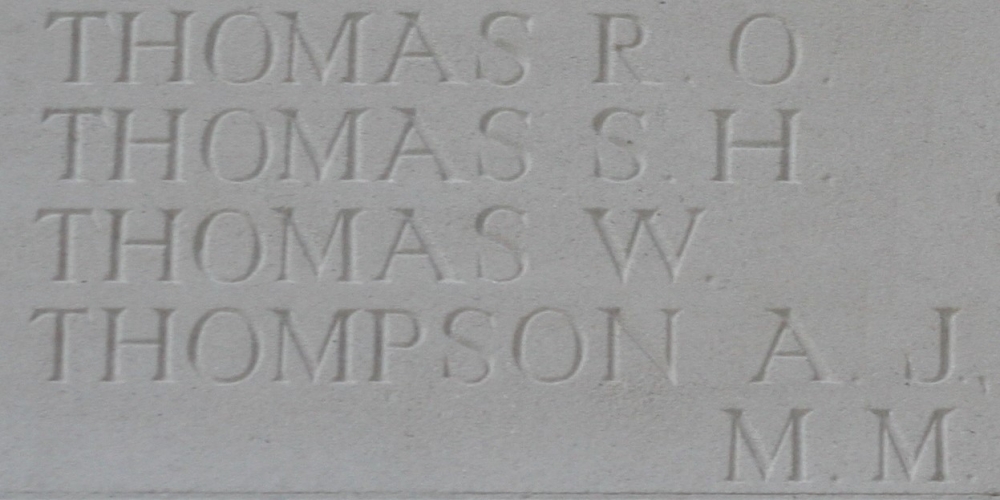
- Age: 26
- From: Runcorn, Cheshire
- Regiment: The King's (Liverpool Regiment) 17th Btn
- K.I.A Sunday 30th July 1916
- Commemorated at: Thiepval Memorial
Panel Ref: P&F1D8B &8 C.
Samuel Harland Thomas was born in the summer of 1889 in Halton, outside Runcorn, Cheshire, the son of Samuel Thomas and his wife Rachel (née Cook). He was baptised two years after his birth, on 12th July 1891 in Aston-by-Sutton, Cheshire. His parents married in 1884 in Chester, where their two eldest children were born, Elsie Elizabeth and Ethel Rachel.
By 1889 they had moved to the Runcorn area, where three more children were born: Samuel, Sarah Alice, and Frank, and Anna (Annie) Louisa was born in 1898 in Helsby.
At the time of the 1891 census his father is the station master at Halton Station, Sutton. They live on the premises and have two daughters and Samuel, age 1.
By 1901 his father is the station master in Frodsham, Cheshire. They have six children; eldest daughter Elsie, 15, is a dressmaker’s apprentice, Ethel is 13, Samuel 11, Alice 8, Frank 5, and Annie is 2.
The 1911 Census shows the family living at the Railway Station House, Frodsham. His father Samuel aged 51, born 1860 in Christleton, Cheshire occupation shown as station master. His mother, Rachel, is aged 53, born 1858 in Liverpool with no occupation shown. They have been married for twenty six years and have had six children. Those listed at home at the time of the Census are; Samuel Harland aged 21, is a railway clerk, Frank aged 15, born 1896 occupation rubber coverer in a cable works were born in Runcorn and Anna Louisa aged 12, born 1899 is at school and was born in Helsby, Cheshire.
His sisters, Elsie, 25, Ethel, 23, and Alice, 18, are in domestic service in Frodsham.
In 1913 at Frodsham Court House, claims for eligibility to vote were reviewed (apparently on the basis of paying for lodgings, therefore not a dependent family member). The Runcorn Weekly News reported on 3rd October:
“Samuel Harland Thomas claimed a vote for lodgings in the house of his father, Samuel Thomas, at the station, Frodsham. He was twenty-three years of age, paid 15s. a week board and lodgings, and had occupied a separate bedroom for two years. The agents had no questions [….] the vote was allowed.”
Before the outbreak of war he was employed as a clerk with London & North Western Railway at Warrington (District General Manager's Office, Goods Dept).
He enlisted at St Geroge's Hall in Liverpool on 02nd September 1914, joining the 17th Battalion of The King’s Liverpool Regiment as Private 15938. He gave his age as 25 and (3 months or 33 days, not clear), and his occupation as clerk. He is described as being 5’ 9 and a half inches tall, weighing 124 lbs, with a fair complexion, blue eyes, and fair hair.
He was billeted at Prescot Watch Factory from 14th September 1914, he trained there and also at Knowsley Hall. On 30th April 1915 the 17th Battalion alongside the other three Pals battalions left Liverpool via Prescot Station for further training at Belton Park, Grantham. They remained here until September 1915 when they reached Larkhill Camp on Salisbury Plain.
Harland shipped to France with his battalion, disembarking at Boulogne on 07th November 1915.
He was killed in action on the 30th July 1916, aged 26, at the village of Guillemont, France, during the Somme Offensive.
Details of his death are featured in Graham Maddocks book “Liverpool Pals” (p.123-4) and gives details of the events:-
No.3 and No.4 Companies, intermingled because of the fog, soon came across a small German strongpoint on their line of advance, just to the south of Arrowhead Copse, and after a fierce hand-to-hand encounter, they captured it. Two friends from Chester wrote home separately to describe their experiences.
“We were in reserve for a week just behind the line waiting for our third attack. On the night of 29th July we moved up to our position just ahead and on the right of Trones Wood. Here we took up our position in shell holes just behind the 19th, and dug ourselves in for safety, awaiting early morning when the advance was due to take place at 4.45. We were in our stations, myself being with Ossy Eyes [Pte 15985 J.O. Eyes]. Frank [16016 F.A. Pierce] and his mates were quite near, also Sam’s [15938 S.H. Thomas] gun team. We were under constant fire, but not heavy, being mostly gas shells. It would be towards one or two o’clock when poor old Sam met his fate. Our sergeant had just given us our rum ration and gone to the shell hole where the gun team were, and here, unfortunately, one gas shell found its mark, landing in the centre of the gunners. Poor lads, it wiped the whole of them out.
It was a bad start for us, but at 4.45 the boys were up – into the mist they went headed by our section commanders. We ploughed along taking shelter here and there, for they poured one continual rain of lead at us. We were suffering terrible losses but the boys kept on. When we first started the attack, I saw Frank leading his section on. He was on our right, but he disappeared into the mist. We kept pushing forward and were then held up by a German advance trench (a strong point). Here we fought for three-quarters of an hour, when the enemy saw their chance was hopeless they downed arms, hands up, and cried like children for mercy.
We took up our position in what was once the German trench – only three of us out of our section, our NCO, Ossy, and myself. Getting lost, we attached ourselves to the 19th. Here we met another of our Pals who had also got lost. He was one of Frank’s section. Then he told us the terrible news. Frank was leading his section in the charge, and unfortunately was shot through the heart. The sights were bad enough, but the shock of losing Frank and Sam as well! I can’t describe my feelings – it’s heart-breaking. They were two fine fellows, so very popular in the company, and not only were they excellent soldiers, but thorough gentlemen too!” - 15971 Lance Corporal H. Foster (who survived the war).
“Ossy Eyes [15985, J.O. Eyes] and I who managed to come out of this without a scratch are badly cutup over this terrible affair, and I know you, and all those who know those dear comrades of ours will be badly upset about it. Poor old Charlie [21518 C. Heath] met his death while performing a very brave act. Our battalion were in the first wave that went over, and when we advanced so far, we got orders to get down, and Charlie, who noticed a German machine-gun a few yards ahead of him, charged with one or two others to try and capture it, but was fatally hit by a bomb. Frank Pierce [16016 F.A. Pierce] was sniped through the head and Sam Thomas [15938 S.H. Thomas] was knocked out by a gas shell while going up the trenches the night previous to the attack. Gordon Pinches [21589 N.G. Pinches] was killed with a bullet, but where it caught him exactly, I could not say.” – 21646 Private C.J. Wright (recipient of the Military Medal, himself hit and killed by an aerial bomb on 8th October 1918, just a month before the Armistice).
The 17th Battalion Diary for 30th July 1916 gives further details of the days action:
The Battalion was in support to 19 & 20 Battalions K.L.R. 2 Coys. behind 19th & 2 Coys. behind 20th. Very thick mist. The attack was pushed home to the objective in places but in the main was held up by machine gun fire from hidden machine guns.
Fighting continued all day swaying backwards and forwards until by 6pm about 300 yards in depth had been gained & consolidated all along our front.
Casualties in the 17th Battalion were 15 Officers and 281 Other Ranks
Further details are reported in more detailed by Everard Wyrall in his book The History of the King’s Regiment (Liverpool) 1914-1919 Volume II 1916-1917
The 17th King’s had advanced (two companies each behind the 19th and 20th Battalions) in small columns. They too suffered heavily from machine-gun fire and were quickly absorbed into the waves that preceded them. They also shared the gains and losses of that terrible day.
When darkness fell on the battlefield the 30th Division held a line from the railway on the eastern side of Trones Wood , southwards and including Arrow Head Copse, to east of Maltz Horn Farm. On this line the division was relieved by the 55th Division during the early hours of the 31st July.
The events of 30th July 1916 were regarded at the time as Liverpool’s blackest day. There follows an extract from The History of the 89th Brigade written by Brigadier General Ferdinand Stanley which gives an indication of the events of the day.
Guillemont
Well the hour to advance came, and of all bad luck in the world it was a thick fog; so thick that you couldn’t see more than about ten yards. It was next to impossible to delay the attack – it was much too big an operation- so forward they had to go. It will give some idea when I say that on one flank we had to go 1,750 yards over big rolling country. Everyone knows what it is like to cross enclosed country which you know really well in a fog and how easy it is to lose your way. Therefore, imagine these rolling hills, with no landmarks and absolutely unknown to anyone. Is it surprising that people lost their way and lost touch with those next to them? As a matter of fact, it was wonderful the way in which many men found their way right to the place we wanted to get to. But as a connected attack it was impossible.
The fog was intense it was practically impossible to keep direction and parties got split up. Owing to the heavy shelling all the Bosches had left their main trenches and were lying out in the open with snipers and machine guns in shell holes, so of course our fellows were the most easy prey.
It is so awfully sad now going about and finding so many splendid fellows gone.
Harland's body was not recovered from the battlefield or was subsequently lost as he has no known grave and is commemorated on the Thiepval Memorial.
The Thiepval Memorial, the Memorial to the Missing of the Somme, bears the names of more than 72,000 officers and men of the United Kingdom and South African forces who died in the Somme sector before 20 March 1918 and have no known grave. Over 90% of those commemorated died between July and November 1916.
On 01st August 1932 the Prince of Wales and the President of France inaugurated the Thiepval Memorial in Picardy. The inscription reads: “Here are recorded the names of officers and men of the British Armies who fell on the Somme battlefields between July 1915 and March 1918 but to whom the fortune of war denied the known and honoured burial given to their comrades in death.”
His death was reported in the Chester Chronicle on 19th August 1916:
“Mr. S. Thomas, the Frodsham stationmaster, has now received information that his son, Pte. Samuel H. Thomas, was killed on the 31st [sic] July. The first intimation that misfortune had befallen him was contained in a letter from a Warrington gentleman, who, referring to Pte. Thomas and a Crewe soldier named Jackson, wrote:- ‘The last time my son saw them was on Saturday night, the 29th July, just before going into some kind of action. My son afterwards enquired after them and found out that two days after the battalion returned Jackson was wounded and your son missing.’ Pte. Thomas, who was 27 years of age, joined the 17th King’s Liverpool Regiment at the commencement of the war and had been at the front since October of last year. He was formerly in the goods manager’s office at Park House, Warrington.”
In November 1916 his parents were notified that there were no personal effects to be sent, but later received three letters.
Probate was granted in the amount of £89 to his father, who also received his son’s Army pay and a War Gratuity of £8-10s. His mother was awarded a pension of 10/6d a week from April 1917, increased to 12/6d.
On the anniversary of his death his family placed an In Memoriam notice:
“In loving memory of Pte. S. Harland Thomas (Liverpool Pals), who was killed in action on July 30th, 1916, aged 26 years. Fondly remembered by all at Station House, Frodsham. Greater love hath no man than this, that a man lay down his life for his friends.”
Also in the Liverpool Echo, on 30th July 1917 under the heading ‘Lost At The Battle of Guillemont’ firends paid tribute to their fallen "chums":
Pierce, Heath, Pinches, and Thomas – To the memory of Frank Pierce, Charles Heath, Gordon Pinches, and Sam Thomas, K.L.R. (Pals), killed in action on Sunday, July 30, 1916, at Guillemont. (Ever dear to all their Chums.)”
Harland was also remembered on the second anniversary of his death in 1918:
"In loving memory of S. Harland Thomas (Liverpool Pals), who was killed in action July 30, 1916. ("Greater love hath no man than this, that a man lay down his life for his friends.") - Fondly remembered by all at Station House, Frodsham."
In 1919 all his siblings were living at home at the Station House, Frodsham: Frank 24, and sisters Elsie 34, Ethel 32, Alice 26, and Louisa 20.
His mother died in 1927 aged 69. His father retired in 1926 after over half a century with the railway, and died in 1930 aged 71.
Harland is commemorated on the following memorials -
Frodsham Memorial
St. Laurence, Frodsham
And on the family gravestone in St. Laurence’s Churchyard, Frodsham -
IN LOVING MEMORY OF
ALSO OF HARLAND, THEIR SON,
KILLED IN ACTION 30TH JULY 1916
AGED 26 YEARS
AT REST
THY WILL BE DONE
We currently have no further information on Samuel Harland Thomas, If you have or know someone who may be able to add to the history of this soldier, please contact us.
Killed On This Day.
(110 Years this day)Wednesday 16th August 1916.
2nd Lieut Bryn Atherton Brodie Thomas
19 years old
(110 Years this day)
Wednesday 16th August 1916.
Lance Serjeant 24726 Charles Fife
24 years old
(110 Years this day)
Wednesday 16th August 1916.
Pte 29706 Herbert Noble
38 years old
(109 Years this day)
Thursday 16th August 1917.
Pte 16529 Rupert King
34 years old
(109 Years this day)
Thursday 16th August 1917.
2nd Lieutenant Alexander Spears
24 years old
(109 Years this day)
Thursday 16th August 1917.
Pte 24567 Frederick Kennedy
35 years old