
1885 - 1916
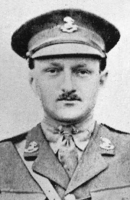
CPL David Wallace Crawford
1887 - 1916
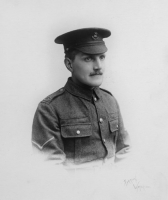
Lce-Corpl John Joseph Nickle
1894 - 1916
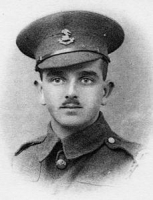
Pte 17911 Morton Neill
1897 - 1916
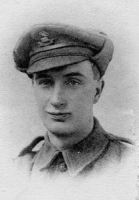
Lieut Edward Stanley Ashcroft
1883 - 1918
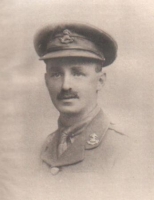
Pte 27579 Hugh Sampson

- Age: 24
- From: Loops Head
- Regiment: The King's (Liverpool Regiment) 17th Btn
- K.I.A Sunday 30th July 1916
- Commemorated at: Serre Rd No 2 Cem, B-hamel
Panel Ref: IX.L.3
Hugh Sampson was born on the 15th December 1891 at Loop Head Lighthouse, Loop Head, County Clare, Ireland, the son of William Parnell Sampson and his wife Elizabeth Ann (nee Simpson). Loop Head Lighthouse, a headland on the north side of the River Shannon in Co. Clare, is 70 miles west of Limerick. (Scenes from Star Wars: The Last Jedi were filmed at Loop Head.) Hugh's father was a lighthouse keeper and his work took him to a number of posts around Ireland and beyond.
His father was born in County Down, and his mother was a British Subject born in India. They married in Cork in 1885 and had eight children. Hugh had older siblings William A.R., born in 1887, Alice Mary 1889, and Emily Elizabeth 1890, all born in County Cork, after which the family moved to County Clare where Hugh and younger siblings Ada Gertrude 1893, and John Walter 1894, were born. Richard George 1897 and James Roberts 1900 were born in County Mayo (all birthdates approximate). The family were Church of Ireland (Protestant).
At the time of the 1901 census they are living in St. Maur's Terrace, Queenstown (now Cobh) in County Cork, with eight children aged 7 months to 13 years. His father, 42, is a lighthouse keeper, his mother is 39, and Hugh is 9.
Hugh joined the Merchant Service as a Boy in 1909 at 17 in Limerick, and is found on three crew lists, his first ship the Granuaile, earning 12/- a week. In June 1910 aged 18 he is listed as an Ordinary Seaman on the S.S. Doonass (home trade).
The 1911 census finds Hugh as an Ordinary Seaman, aged 19, on board ship in Larne, Northern Ireland.
His parents, with five of his siblings, are living in Talbert Island, County Kerry (on the south bank of the Shannon), where his father is the principal lighthouse keeper. They have been married 25 years, all their children still living. It appears that at some point his father worked as the lighthouse keeper at Duncannon Fort lighthouse, on the Hook Peninsula, County Wexford.
Later in 1911 Hugh signed on with the Ambrose (Booth Line) for a South American trip, earning £4-10 a month, giving his age as 19 and his address as the Sailors' Home, Liverpool. The ship left Liverpool on 21st August, calling at Lisbon, Paramaraibo, and Manaus, and returned on 13th October 1911. (Hugh's name does not appear on the Booth Line Roll of Honour.)
He enlisted in Liverpool, the amount of the War Gratuity suggesting he joined up in about April 1915, joining the 17th Battalion, The King’s Liverpool Regiment as Private No 27579. SDGW gives his residence as Duncannon Fort before enlistment.
On 30th April 1915 the 17th Battalion alongside the other three Pals battalions left Liverpool via Prescot Station for further training at Belton Park, Grantham. They remained here until September 1915 when they reached Larkhill Camp on Salisbury Plain.
Hugh did not ship overseas with the majority of the 17th Battalion, but arrived in France nearly two months later, on 29th December 1915, thereby earning his 1914-1915 Star.
He was killed in action on the 30th July 1916, aged 24, at the village of Guillemont, France, during the Somme Offensive. The Battalion diary gives details of the action on that fateful day:
17th Battalion Diary 30th July 1916
The Battalion was in support to 19 & 20 Battalions K.L.R. 2 Coys. behind 19th & 2 Coys. behind 20th. Very thick mist. The attack was pushed home to the objective in places but in the main was held up by machine gun fire from hidden machine guns.
Fighting continued all day swaying backwards and forwards until by 6pm about 300 yards in depth had been gained & consolidated all along our front.
Casualties in the 17th Battalion were 15 Officers and 281 Other Ranks
Further details are reported in more detailed by Everard Wyrall in his book The History of the King’s Regiment (Liverpool) 1914-1919 Volume II 1916-1917
The 17th King’s had advanced (two companies each behind the 19th and 20th Battalions) in small columns. They too suffered heavily from machine-gun fire and were quickly absorbed into the waves that preceded them. They also shared the gains and losses of that terrible day.
When darkness fell on the battlefield the 30th Division held a line from the railway on the eastern side of Trones Wood , southwards and including Arrow Head Copse, to east of Maltz Horn Farm. On this line the division was relieved by the 55th Division during the early hours of the 31st July.
The events of 30th July 1916 were regarded at the time as Liverpool’s blackest day. There follows an extract from The History of the 89th Brigade written by Brigadier General Ferdinand Stanley which gives an indication of the events of the day.
Guillemont
Well the hour to advance came, and of all bad luck in the world it was a thick fog; so thick that you couldn’t see more than about ten yards. It was next to impossible to delay the attack – it was much too big an operation- so forward they had to go. It will give some idea when I say that on one flank we had to go 1,750 yards over big rolling country. Everyone knows what it is like to cross enclosed country which you know really well in a fog and how easy it is to lose your way. Therefore, imagine these rolling hills, with no landmarks and absolutely unknown to anyone. Is it surprising that people lost their way and lost touch with those next to them? As a matter of fact, it was wonderful the way in which many men found their way right to the place we wanted to get to. But as a connected attack it was impossible.
The fog was intense it was practically impossible to keep direction and parties got split up. Owing to the heavy shelling all the Bosches had left their main trenches and were lying out in the open with snipers and machine guns in shell holes, so of course our fellows were the most easy prey.
It is so awfully sad now going about and finding so many splendid fellows gone.
Hugh, like so many of his Pals was declared Missing on 30th July 1916, and his death was later presumed for official purposes as having occurred on that date.
The CWGC Graves Registration report shows that he was originally buried as one of five Unknown British Soldiers of the King's Liverpool Regiment. After the war, when graves were concentrated, their bodies were exhumed, and four were identified by their uniforms and titles (Pte. H. Sampson; 2nd Lt. E.R. Porritt, 17th Bn; Pte. F.J. Garside, 19th Bn; and Pte. A. Lohrenz, 17th Bn, all killed on the same date), and reinterred in Serre Road No.2 Cemetery, Beaumont Hamel, Somme, where all five rest side by side.
In June 1916, the road out of Mailly-Maillet to Serre and Puisieux entered No Man's Land about 1,300 metres south-west of Serre. On 1 July 1916, the 31st and 4th Divisions attacked north and south of this road and although parties of the 31st Division reached Serre, the attack failed. The 3rd and 31st Divisions attacked once more on the 13 November, but again without success.
Early in 1917, the Germans fell back to the Hindenburg Line and on 25 February, Serre was occupied by the 22nd Manchesters. The village changed hands once more in March 1918 and remained under German occupation, until they withdrew in August.
In the spring of 1917, the battlefields of the Somme and Ancre were cleared by V Corps and a number of new cemeteries were made, three of which are now named from the Serre Road. Serre Road Cemetery No.2 was begun in May 1917 and by the end of the war it contained approximately 475 graves (Plots I and II, except for Row E, Plot II which was added in 1922 and Row AA, Plot I which was added in 1927), but it was greatly enlarged after the Armistice by the addition of further graves from the surrounding area.
There are now 7,127 Commonwealth burials of the First World War in the cemetery, mostly dating from 1916. Of these, 4,944 are unidentified.
The cemetery, which was not completed until 1934, was designed by Sir Edwin Lutyens.
Dublin Daily Express - Thursday 14 September 1916
Missing.
King’s Liverpool Regt. - 27579, H. Sampson(Wexford);
His father, William, received Hugh's Army effects, and a War Gratuity of £4-10s. A pension card exists (no amount or date of award shown) in the name of his mother Elizabeth, Quail (or Quoil) Bridge, Downpatrick, County Down.
His mother ("wife of William Sampson, late Irish Lights") died suddenly on 12th July 1923, in Victoria Terrace, Larne. Some time after her death his father lived at 18 Eglington Road, Ardrossen, Ayrshire, Scotland (which also had a lighthouse, on the Firth of Clyde). The name of his sister Miss Alice M. Sampson, Fort Duncannon, Co. Wexford also appears on a pension card.
His father died in Ardrossan in 1936, by then a Commissioner, Irish Lights. He was brought back to Ireland, where he was buried with his wife in Larne New Cemetery.
Hugh is commemorated on Ireland's National Roll of Honour.
Grateful thanks are extended to Hugh's great niece Elizabeth Page for details of his birth and his age. Elizabeth also advises that the family story is that Hugh and his older brother John travelled to Liverpool to join the Kings Regiment without telling their family. It isn’t known if Hugh ever saw his parents and siblings again. His brother, John, was gassed in the trenches and died at approx age 34 in Kilwinning, Scotland, which is about 5 miles from Ardrossan, where his father was living. It has not been established which Regiment that John served with.
We currently have no further information on Hugh Sampson, If you have or know someone who may be able to add to the history of this soldier, please contact us.
Killed On This Day.
(110 Years this day)Friday 20th October 1916.
L/Cpl 22676 Albert Dunstan
29 years old
(110 Years this day)
Friday 20th October 1916.
Pte 22677 Alfred Dutton
33 years old
(110 Years this day)
Friday 20th October 1916.
Pte 21574 Henry McDowall
25 years old
(110 Years this day)
Friday 20th October 1916.
Sgt 22782 Ellis Molyneux
30 years old
(110 Years this day)
Friday 20th October 1916.
A/CSM 22181 Reginald William Moulton
28 years old
(110 Years this day)
Friday 20th October 1916.
Pte 35948 Albert Newton
26 years old
(110 Years this day)
Friday 20th October 1916.
Pte 23127 Charles Henry Nickson
19 years old
(110 Years this day)
Friday 20th October 1916.
Pte 52217 Norman Samuel Rowe
19 years old
(110 Years this day)
Friday 20th October 1916.
Pte 23841 Alexander Taylor
20 years old
(110 Years this day)
Friday 20th October 1916.
Pte 23856 Samuel John Webber
23 years old
(110 Years this day)
Friday 20th October 1916.
Pte 51609 George Whitehead
20 years old
(110 Years this day)
Friday 20th October 1916.
Pte 37905 William Williams
35 years old
A total of 20 Pals were killed on this day. View All