
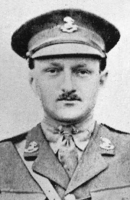
Capt Arthur de Bells Adam (MC)
1885 - 1916
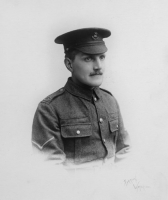
CPL David Wallace Crawford
1887 - 1916
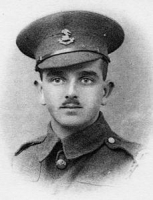
Lce-Corpl John Joseph Nickle
1894 - 1916
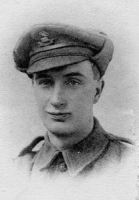
Pte 17911 Morton Neill
1897 - 1916
Lieut Edward Stanley Ashcroft
1883 - 1918
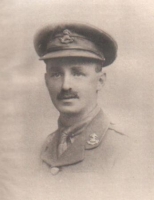
1885 - 1916
CPL David Wallace Crawford
1887 - 1916
Lce-Corpl John Joseph Nickle
1894 - 1916
Pte 17911 Morton Neill
1897 - 1916
Lieut Edward Stanley Ashcroft
1883 - 1918
Sgt 14520 George Robbins
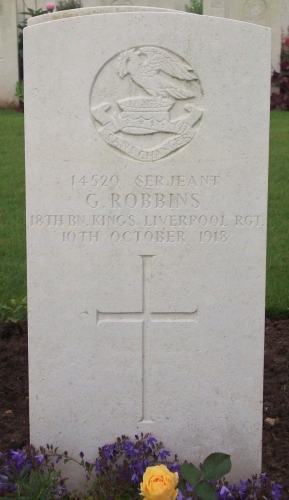
- Age: 23
- From: Liverpool
- Regiment: The King's (Liverpool Regiment) 18th Btn
- K.I.A Thursday 10th October 1918
- Commemorated at: Le Cateau Mil Cem
Panel Ref: V.G.7
George Herbert Robbins was born in Everton, Liverpool, on 22nd March 1895, the youngest son of John Thomas Robbins and Sarah Ann Seddon (née Fawcett). His parents, both from Liverpool, married in St. Peter’s in 1887 when his father was 19 and his mother 18. They had seven children, one of whom died in infancy. George had older siblings Gertrude, born in 1888, Florence, 1890, and John 1893, and younger sisters Dorothy, 1899, and Violet, born in 1903. George was baptised in St. Peter’s on 27th May, 1895, his parents living in Poplar Street, and his father’s occupation listed as carter.
In 1901 his parents, with five children, are living at 1 Poplar Street. His father is a railway carter, George is 6. Also in the household are Sarah’s mother, with her husband and two daughters. His sister Dorothy died later that year aged 2.
In 1911 George, with his parents and brother John, are living at 16 Eaton Place, Everton. His father, 41, is a railway carter, his mother is also 41, John, 18, is a railway company porter, and George, 16, is a general carter. Also in the household is Ellen Hodgson, 64, his maternal grandmother. His younger sister Violet, 8, is living with married sister Florence, 21, in Stoke on Trent.
George enlisted in Liverpool on 2nd September 1914, as Private 14520, Joining the 14th Battalion of The King’s (Liverpool) Regiment, giving his age as 19 years and 340 days. (The reason for the discrepancy in birthdate is not known. George would have been 19 years old and had no need to give a false birthdate.) He is described as being 5’ 8” tall, weighing 135 lbs, with a sallow complexion, hazel eyes and brown hair, and a scar on his chest. He gives his occupation as driver and his parents, Sarah and John, of 26 Lloyd Street, as his next of kin.
Posted to ‘B’ Company, 14th Bn 17/9/1914
Appointed Lance Corporal 13/8/1915
To France 4/9/1915 at Boulogne
Promoted to Corporal 16/9/1915
Embarked for the Balkans (Salonika) 28/10/1915
Promoted Sergeant 23/12/1915
To 68 Field Ambulance 12/10/1916 with malaria, admitted
Rejoined unit in the field 4/12/1916
To 68 Field Ambulance 22/12/1916
Admitted 4th Canadian Hospital, Salonika 23/12/1916
Evacuated to Malta on Hospital Ship ‘Grantully Castle’ Jan 1917
Ghajn Tuffieha Camp, Malta 31/1/1917
To All Saints convalescent camp, Malta
Unfortunately the next segment of his record is illegible, but George rejoined his unit in the field on 9/10/1917, then on 19/6/1918 was transferred from the Mediterranean theatre, embarking at Itea in Greece and disembarked at Taranto, Italy (in the heel of Italy, which was a transit point for troops).
Granted leave from 24/7/1918 to 8/8/1918
Rejoined from leave 11/8/1918
The 14th Bn, recently returned from Salonika, is amalgamated with the 18th Bn K.L.R. in August 1918 and becomes the 18th (Lancashire Hussars) King’s (Liverpool) Regiment. The Hundred Days Offensive, the Allied push which would eventually end the war, begins on 8th August, 1918.
On 7th October 1918 the 18th Bn arrives at the Hindenberg Line at Bony. From the battalion War Diary:
10th October 1918 - At 0230 hours the battalion moved forward to a position near RUEMONT, and attacked towards LE CATEAU at 0510. Very little opposition was met with at the start but later considerable M.G. fire was encountered. … Our right company was not in touch with the flank, and the troops on the right appeared to be held up by M.G. fire from the railway embankment … A short length of trench on the high ground immediately E. of LE CATEAU was also reported to be held by the enemy. At 0848 the Centre Coy reached K.33.b and pushed a platoon into the N. W. outskirts of LE CATEAU. The right company was temporarily held up by MG and sniper fire, but appeared to be almost in the town itself. Hostile M.G. fire was reported from the direction of Q.10. … Houses in K.28.a were reported to be strongly held by the Bosche, and a patrol was sent out to investigate and deal with them. … During the advance on LE CATEAU considerable difficulty was experienced, owing to a “whizz bang” battery being able to fire over open sights at the troops as they moved up the rise and along a slight valley.
Total Casualties from 7th to 13th October:
Killed – 2 Officers, 18 O.R.
Wounded – 6 Officers, 111 O.R.
Died of Wounds – 1 O.R.
Wounded and Missing – 1 Officer, 20 O.R.
George was declared Missing on 10th October 1918; for official Army purposes his death in action or from wounds was presumed to have occurred on or shortly after that date. (The CWGC Graves Registration Forms show date of death 27th October 1918.) He was 23 years of age.
George now rests at Le Cateau Military Cemetery, Nord, France.
Le Cateau-Cambrésis and the country to the west of it was the scene of a battle fought by the British II Corps on 26 August 1914 against a greatly superior German force. The town remained in German hands from that date until the evening of 10 October 1918, when it was rushed by the 5th Connaught Rangers and finally cleared a week later. During the war Le Cateau had been a German railhead and the site of an important hospital centre. The military cemetery was laid out by the Germans in February 1916 with separate plots for the Commonwealth and German dead. It contains the graves of over 5,000 German soldiers, many of whom were buried during the occupation, the rest being brought in from other German cemeteries after the Armistice. A separate plot contains the graves of 34 Russian prisoners of war who died in captivity. The Commonwealth plot is the site of almost 700 graves and commemorations of the First World War. The majority of the graves in Plots I, III, IV and V are those of British dead buried by the Germans, mainly from the battleground of 1914; Plot II contains entirely graves of October and November 1918, eight of which were brought in after the Armistice.
George’s name appeared in the list of Missing in the Weekly Casualty List on 10th December 1918.
His personal effects were sent to his mother in November 1919: 1 letter.
George served in the Army for 4 years and 39 days; he earned his three medals.
His mother Sarah Ann, living at 26 Lloyd Street, Everton, received his effects of £28-8-8d as well as a War Gratuity of £27. From the two Pension cards, one stating Killed in action, the other stating Missing, it is not clear that his parents received a pension.
In 1939 his parents John and Sarah Ann were still living at 26 Lloyd Street; his father now retired. They lived through the second world war; his father died at the age of 76 in December 1945 and his mother in 1950 at age 79, still living in Lloyd Street.
Sadly, George has not been found on any memorials.
We currently have no further information on George Robbins, If you have or know someone who may be able to add to the history of this soldier, please contact us.
Killed On This Day.
(110 Years this day)Thursday 19th October 1916.
C.S.M 15156 Frederick Preston Beckett
34 years old
(110 Years this day)
Thursday 19th October 1916.
Pte 53077 Walter Bullimore
27 years old
(110 Years this day)
Thursday 19th October 1916.
Pte 33720 William Clarke
21 years old
(110 Years this day)
Thursday 19th October 1916.
Pte 52010 Thomas Francis Cross
24 years old
(110 Years this day)
Thursday 19th October 1916.
L/Cpl 16381 William Leyland
31 years old
(110 Years this day)
Thursday 19th October 1916.
Pte 53196 Stephen Mannion
18 years old
(110 Years this day)
Thursday 19th October 1916.
Pte 52028 George Edward Vernon
23 years old
(109 Years this day)
Friday 19th October 1917.
L/Cpl 49197 Robert William Dugdale
34 years old
(109 Years this day)
Friday 19th October 1917.
Pte 32328 George Arthur Stewart
29 years old
(108 Years this day)
Saturday 19th October 1918.
Pte 27167 John Howarth
21 years old