
1885 - 1916
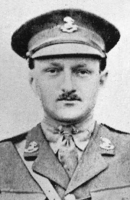
CPL David Wallace Crawford
1887 - 1916
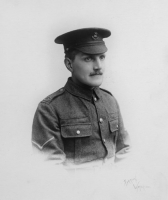
Lce-Corpl John Joseph Nickle
1894 - 1916
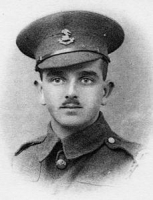
Pte 17911 Morton Neill
1897 - 1916
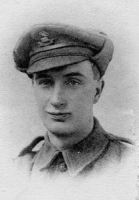
Lieut Edward Stanley Ashcroft
1883 - 1918
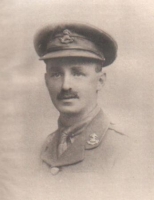
Pte 51968 George Frederick Jones
- Age: 18
- From: Abergele, N.Wales
- Regiment: The King's (Liverpool Regiment) 17th Btn
- K.I.A Thursday 12th October 1916
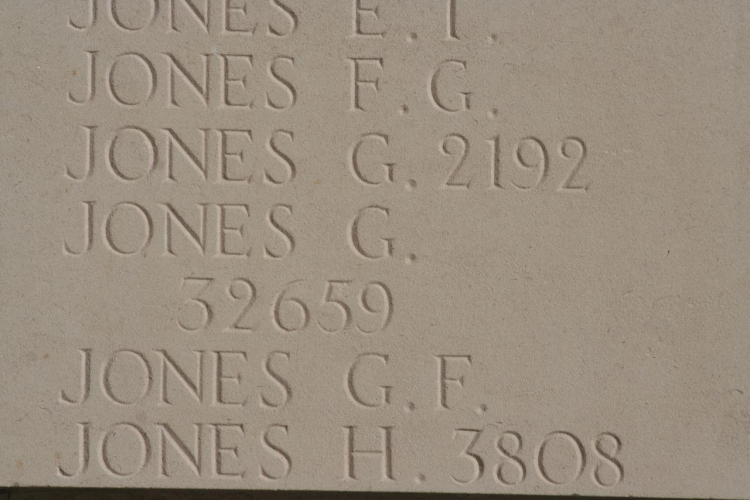
- Commemorated at: Thiepval Memorial
Panel Ref: P&F1D8B &8 C.
George Frederick Jones was born in Abergele in late 1897 or early 1898, the second son of William Henry Jones and his wife Martha (née Rimmer), and baptised in Rhyl on the 9th March 1898, parents address 24 Abbey St. His father was born in St. Asaph, Flintshire, and spoke both English and Welsh. His mother was from Liverpool. They married in late 1894 in St Asaph and had three children. George had an older brother, William Lothian, born in 1896, and a younger brother, Harold Edgar, born in 1907. George was raised speaking both languages.
In 1901 the family is living at Penybont House, Abergele. His father, 30, is a plumber, his mother is 28, William is 5, George is 3. They have a domestic servant, a boarder, and a visitor from Ireland, Margaret Williams, 34, a Hospital nurse.
The 1911 Census shows the family living at the same address.
The father, 40, is a master plumber and house painter, his mother is 38 and they have been married for married 16 years and have 3 children, William aged 14 and George aged are both at school and Harold is aged 3.
17th Bn War Diary: Battle of Transloy Ridge –
11-10-16 - Gird Trench/Gird Support – Battalion in front line and support trenches. British bombardment of enemy front line system commenced about midday. Hostile shelling was intermittent throughout the day.
12-10-16 - Our bombardment continued. Enemy reply weak. 2.5 p.m. Zero hour. Attack on German front line system commenced. Enemy wire was found to be uncut and attack was unsuccessful. Hostile machine gun fire was very heavy and caused many casualties. Battalion H.Q. and Support Trench were heavily shelled throughout afternoon and evening. […] During this action all communication had to be carried out by runners and carrier pigeons as all wires were being continually cut by enemy shelling.
Casualties: 5 officers killed, 5 officers wounded, 38 OR killed, about 225 OR wounded/missing etc.
Graham Maddocks, in “Liverpool Pals” p.140, adds: “As the whistle blew, the 17th Battalion left its trenches to move forward. […] As soon as the attacking waves left their trenches the enemy artillery began to register on them, and at the same time, the defending infantry commenced a murderous rain of fire. […] Although their numbers had been depleted by the British bombardment, they were trained and experienced soldiers, well dug in on high ground, and for the most part, looking out on uncut wire. As such, it was virtually impossible for them to miss the City Battalion men struggling to advance in the mud towards them. The 17th Battalion, on the left, was particularly badly hit, as its portion of No Man’s Land contained a slight rise in the ground, and as the troops emerged onto it they were silhouetted against the sky and became easy targets. Those on the left of the attack, who managed to avoid the hail of bullets and make it to the German wire, then found that it was totally uncut, and thus trapped, they too became easy targets, to be picked off almost at the enemy’s will. It was hardly surprising that, seeing the first waves being wiped out, some of the following waves turned back and made for their start lines. These lines were now packed with other waves of troops, however, and the fleeing men added to the congestion already there, and became easy prey for the German gunners. There is some evidence also, to suggest that at this stage, the British trenches were also being hit by their own heavy artillery shells which were falling short.”
George Frederick has no known grave and is commemorated on the Thiepval Memorial to the Missing of the Somme, France.
The Thiepval Memorial, the Memorial to the Missing of the Somme, bears the names of more than 72,000 officers and men of the United Kingdom and South African forces who died in the Somme sector before 20 March 1918 and have no known grave. Over 90% of those commemorated died between July and November 1916.
On 01st August 1932 the Prince of Wales and the President of France inaugurated the Thiepval Memorial in Picardy. The inscription reads: “Here are recorded the names of officers and men of the British Armies who fell on the Somme battlefields between July 1915 and March 1918 but to whom the fortune of war denied the known and honoured burial given to their comrades in death.”
North Wales Weekly News 2nd Nov 1916
ABERGELE MAN WOUNDED.
Official news reached Mr. and Mrs. W. H. Jones, Penybont House, Abergele, on Sunday morning that their young son, Private Teddy Jones had been severely wounded in action. " Teddy " was under 18 when he joined the Liverpool Scottish, but he was keen on soldiering, and once in khaki he was keener still on going out to the front. Everyone in Abergele will wish the gallant lad a speedy recovery.
North Wales Weekly News 7th Dec 1916
PRIVATE F. JONES, ABERGELE
It is about a month since Mr. and Mrs. W. H. Jones, Penybont House, Abergele. received intimation from the War Office that their son, Private Freddy Jones, was wounded in action. From that day to this the anxious parents have heard nothing more about their lad, although they have made repeated enquiries to various quarters. Should paragraph meet the eye of anyone who can give any information to the father and mother concerning their young son, they would esteem it a great kindness if he would communicate with them.
North Wales Weekly News 13th March 1919
HANDSOME DONATION PROMISED.
Mr. G. Perkins held similar views, and suggested e monument, towards which he knew of a certain person who was prepared to contribute a handsome donation. Mr. W. P. Morris hoped that those present would not be confused on the question of finance. His idea about a hall was that it should be built by public subscriptions. Mr. W. H. Jones, Penybont House, supported the suggestion of a public garden and a monument.
North Wales Weekly News 30th Oct 1919
OUR FALLEN HEROES.—
At a special vestry meeting held this week, the vicar (Rev. H. R. Hughes) presiding, it was derided to fix a mural in St. Michael's Church in memory of Abergele men (between 60 and 70 in number) who fell in the great war. The marble tablet, measuring 6ft. by 4ft. 4in., is the gift of Mr. W. H. Jones, Penybont House, one of whose sons (Pte. Freddie Jones) made the supreme sacrifice in France. The design of the tablet is that of Mr. Edw. Williams, monumental mason.
OUR FALLEN HEROES.—The church people of Abergele have decided to place a mural tablet in St. Michael's in memory of local men (between 6o and 70) who fell in the great war. The marble tablet is the gift of Mr. W. H. Jones, Penybont House, one of whose sons made the supreme sacrifice in France. The design and the execution of the tablet has been entrusted to Mr. E. Willams, who also lost his only son in the war.
Flintshire County Herald 14th Nov 1919
ABERGELE WAR MEMORIAL AT ABERGELE
It has been decided to erect in the C. E. Mixed School at Abergele a tablet in memory of former scholars who have fallen in the war. The School belongs to the Countess of Dundonald, Gwrych Castle, Abergele, and she has given mission for the memorial to be placed on one of the interior walls of the school. The memorial is to take the form of a finely-sculptured tablet in white Sicilian marble, and made up into two panels which have been given by Mr. W. H. Jones, Penybont House, Abergele, whose son was killed in the war, and on these panels the names of the 45 fallen soldiers will be inscribed. The panels will he flanked by nice marble pilasters, and the cornice and pediment are to be moulded. The memorial has been subscribed for by the former pupils of the school in honour of their fellow pupils who have fallen in the war. The contract for the work has been placed in the hands of Mr. Samuel Welsby, sculptor, Widnes and Mossley Hill, Liverpool, and it is hoped to have the tablet fixed during the Christmas holidays.
We currently have no further information on George Frederick Jones, if you have or know someone who may be able to add to the history of this soldier, please contact us.
89th Brigade On This Day.
110 Years Ago.The Battle of the Transloy Ridges begins. more....
Killed On This Day.
(110 Years this day)Tuesday 17th October 1916.
Pte 21665 William Bertram Morton
33 years old
(110 Years this day)
Tuesday 17th October 1916.
Sgt 16984 John Stanley Orrett
25 years old
(110 Years this day)
Tuesday 17th October 1916.
Capt Guy Ravenscroft
34 years old