
1885 - 1916
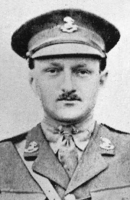
CPL David Wallace Crawford
1887 - 1916
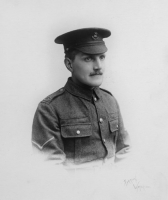
Lce-Corpl John Joseph Nickle
1894 - 1916
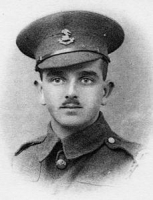
Pte 17911 Morton Neill
1897 - 1916
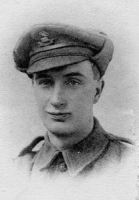
Lieut Edward Stanley Ashcroft
1883 - 1918
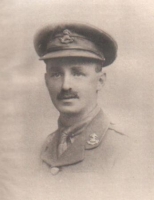
Pte 53112 James Henry Jarman
- Age: 23
- From: Newington Surrey
- Regiment: The King's (Liverpool Regiment) 18th Btn
- K.I.A Tuesday 31st July 1917
- Commemorated at: Hooge Crater Cem, Zillebeke
Panel Ref: IV.G.15
James Henry Jarman was born on the 02nd January 1894 in Southwark, London, son of Thomas William Henry Jarman and Frances Jane Allingham. Thomas had been born in Ramsgate and Frances in Sevenoaks, Kent where they were married in 1892.
At the time of the 1901 census the couple were living at 18 Upper Wimpole Street, once one of the most prestigious streets in London where the cream of society lived, but by the late 19th century many of the houses had been acquired by society doctors and surgeons for practice rooms. James is 7 years old and has a 4 year old sister called Edith Gladys. Their father Thomas aged 34 is recorded as a postman and mother Frances aged 29 is described as a caretaker who would probably have seen to the upkeep of the house. There are no other occupants of the house recorded, but a study of the Post Office directories of the time show that Sir John Milsom Rees practised from this address. He was a a surgeon and a specialist in laryngology and was a consultant for the singers at the Royal Opera House, and for King George V. Young James might have seen some famous faces passing through the door of his home.
The 1911 Census shows James living at 57 Devonshire Street, St Marylebone, London with his family:
The house belonged to Lyttelton Stewart Forbes Winslow and his wife Margaret Anna Gordon Forbes Winslow (who had been born in Liverpool). Forbes Winslow was one of the most famous and controversial psychiatrists of the time. He took over the administration of several asylums founded by his father and also had input in many high profile criminal cases such as the Whitechapel murders and the Florence Maybrick case in Liverpool. Indeed he even alleged he knew the identity of Jack the Ripper, and was most indignant about the sentence passed on Mrs Maybrick. The couple are recorded as being present in the house on the night of the census but Forbes Winslow was an inveterate writer of letters to the newspapers, and had written one published on the 8th April 1911 stating that he and his wife were in Paris at that time, but suggesting a different method for the census to record people who were staying in hotels.
No occupation has been entered for James’s father on this census, but GPO is recorded in the industry column so it can be assumed he is still a postman. No occupation has been entered for Frances either but given there doesn’t seem to be any other household staff, it is a possibility that she is acting as a caretaker or housekeeper for the Forbes Winslows, even though the family are recorded as boarders. James Henry is now aged 17 and employed in the Civil Service working at Somerset House, and his sister Edith is 14 and is still at school. Again, the Jarman family probably saw some interesting sights in that household!
Forbes Winslow died in 1913, and the Jarman family move to Cricklewood. Prior to the war James held a number of positions within the Civil Service:
Boy Clerk: Post Office Savings Bank from November 1909-February 1910.
Boy Clerk: Home Office from February to April 1910.
Boy Clerk: General Register Office April 1910- 31st October 1911.
Assistant Clerk: General Register Office 1st November 1911 - 31st March 1912.
Assistant Clerk: Board of Agriculture and Fisheries 1st April 1912-up to his enlistment.
He enlisted in Cricklewood, London and originally served as Private 20476, East Surrey Regiment. He was transferred to the 18th Battalion, The King’s Liverpool Regiment as Private No 53112. He was killed in action on the 31st July 1917 aged 23 on the first day of the Third Battle of Ypres, better known as Passchendaele.
On this day, before Zero Hour, the 18th Battalion was part of 21st Brigade and was to form up for the attack from trenches from the area of Sanctuary Wood to Observatory Ridge but it was dark and continually falling rain gave very poor visibility. The departure of the 21st Brigade was delayed by heavy shelling.
The 18th King’s began to move forward in the rear of the 2nd Battalion of the Wiltshire Regiment who had been detailed as the left attacking battalion of the 21st Brigade.
No’s 1 and 3 Companies of the King’s led the way followed by No’s 2 and 4. In Sanctuary Wood there was considerable confusion, as a result No.2 and No.4 Companies became separated from the others, and were moved over to the left flank towards positions known as Surbiton Villas and Clapham Junction in the direction of the 90th Brigade.
No.1 and 3 Companies were soon in action with the enemy, and were for a time, held up against an enemy strong point. They pushed forward with their right on a trench known as Jar Row and their left on the tramway south of Stirling Castle. Advance along Jar Row was held up by the Germans who put up a fierce resistance and the party was forced to withdraw.
Another group of men from No.1 and No.3 Companies led by 2nd Lieut. Graham were being held up by another strongpoint which was south of Stirling Castle, which was eventually stormed and taken. Not far away from this action, an attempt, by other men of No.1 and No.3 companies, was made to penetrate a broad belt of uncut wire, but this was covered by Machine-guns which killed almost every man attempting to pass through the two gaps that were discovered.
The situation was similar with No.2 and 4 Companies, who had attacked along the wrong axis. Their advance was met with fierce opposition, and once all the experienced officer’s had been killed or wounded, all cohesion was lost, although some men did reach and cross the Menin Road at Clapham Junction.
By that time, the situation had become extremely confused, and the whereabouts of all four companies being unknown to Battalion Headquarters, urgent attempts were made to discover their locations. Eventually by mid- afternoon, it was established that the bulk of the companies, although all mixed together, were dug in the vicinity of Stirling Castle and by mid evening, the Battalion Headquarters moved forward to meet them.
During its time in the line the 18th Battalion lost 7 officers and 76 men killed or died of wounds and 7 officers and 177 men were wounded. They were relieved on the 2nd August.
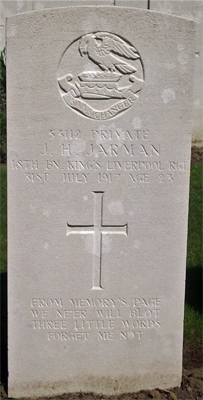
James now lies in Hooge Crater Cemetery, Zillebeke, Belgium. The Inscription on his headstone reads:
“FROM MEMORY'S PAGE WE NE'ER WILL BLOT THREE LITTLE WORDS FORGET ME NOT”
Hooge Chateau and its stables were the scene of very fierce fighting throughout the First World War. On 31 October 1914, the staff of the 1st and 2nd Divisions were wiped out when the chateau was shelled; from 24 May to 3 June 1915, the chateau was defended against German attacks and in July 1915, the crater was made by a mine sprung by the 3rd Division. On 30 July, the Germans took the chateau, and on 9 August, it and the crater were regained by the 6th Division. The Germans retook Hooge on 6 June 1916 and on 31 July 1917, the 8th Division advanced 1.6 Kms beyond it. It was lost for the last time in April 1918, but regained by the 9th (Scottish) and 29th Divisions on 28 September.
Hooge Crater Cemetery was begun by the 7th Division Burial Officer early in October 1917. It contained originally 76 graves, in Rows A to D of Plot I, but was greatly increased after the Armistice when graves were brought in from the battlefields of Zillebeke, Zantvoorde and Gheluvelt and other smaller cemeteries.
There are now 5,916 Commonwealth servicemen of the First World War buried or commemorated in this cemetery. 3,570 of the burials are unidentified, but special memorials record the names of a number of casualties either known or believed to be buried among them, or whose graves in other cemeteries were destroyed by shell fire.
The cemetery was designed by Sir Edwin Lutyens.
He is also commemorated on the Board of Agriculture and Fisheries War Memorial in Defra's headquarters in Nobel House, 17 Smith Square, London. His war gratuity shows he had served for a little over a year.
Soldiers Effects to mother Frances, Pension to mother and father Thomas W. H.
His parents address at the time was 71 Pine Rd, Cricklewood, London. James’s mother died in 1934. The 1939 register shows his father Thomas, listed as a retired postman, still at that address living with his married daughter Edith and her husband Henry Clark. Thomas died later that year aged 72.
Probate was not until 1945
JARMAN - James Henry of 71 Pine Road, Cricklewood Middlesex died 31 July 1917 on war service Administration (with will) Llandudno 24 October to Edith Gladys Clark (wife of Henry Albert Clark). Effects £328 4s 5d.
We currently have no further information on James Henry Jarman, If you have or know someone who may be able to add to the history of this soldier, please contact us.
89th Brigade On This Day.
110 Years Ago.The Battle of the Transloy Ridges begins. more....
Killed On This Day.
(110 Years this day)Monday 16th October 1916.
Pte 22929 Edward Bird
19 years old
(110 Years this day)
Monday 16th October 1916.
Pte 16795 William Frederick Collister
23 years old
(109 Years this day)
Tuesday 16th October 1917.
L/Cpl 49038 Ernest Yardley
31 years old
(108 Years this day)
Wednesday 16th October 1918.
Pte 85187 James Hoy
31 years old
(107 Years this day)
Thursday 16th October 1919.
Pte 36438 Hugh Morris
23 years old