
1885 - 1916
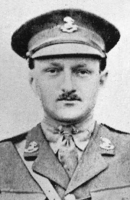
CPL David Wallace Crawford
1887 - 1916
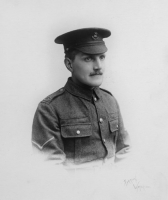
Lce-Corpl John Joseph Nickle
1894 - 1916
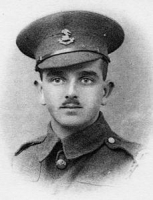
Pte 17911 Morton Neill
1897 - 1916
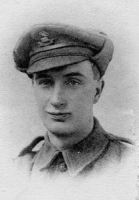
Lieut Edward Stanley Ashcroft
1883 - 1918
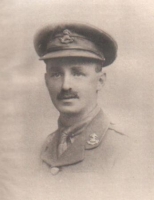
Capt Stanley Cotterell Seymour Horser

- Age: 21
- From: London
- Regiment: The King's (Liverpool Regiment) 17th Btn
- K.I.A Thursday 12th October 1916
- Commemorated at: Thiepval Memorial
Panel Ref: P&F1D8B &8 C.
Stanley Cottrell Seymour Horser was born on 29 December 1894 the son of Percy George Horser and his wife Emily Buckingham who were married in 1892 in Headington, Oxfordshire. He was baptised on the 2nd May 1895 at St Mary and St John, Cowley. Father was a woollen buyer on 19 Divinity Rd. He was educated at New College School, Oxford and Queens College, Oxford. He was in the Cricket XI in 1914 and also played Hockey in 1913-14.
The 1901 Census shows the family living at 19 Divinity Road, Cowley St John, Oxford.
His father Percy G. is aged 36, a woollen born in Oxford. His wife Emily is aged 34, born in Eynsham, Oxfordshire. They have two children Gladys K. aged 7, and Stanley C.S. aged 6, both scholars born in Cowley St John. They also have a boarder Louisa Chappell aged 40.
The 1911 Census shows the family living at 37 Beechcroft Road Summertown Oxford.
His father Percy George is aged 46, born 1865 and occupation Tailors Manager and was born in Oxford. His wife Emily is aged 44, born 1867 in Eynsham, Oxfordshire. They have two children Gladys Kate aged 17, born 1894 and Stanley aged 16, both at school and born in Oxford. They also have a General Domestic Servant Kate Higgs, aged 16, born 1895 in Wolvercote, also in Oxfordshire living at the address.
Stanley received a commission on the 30th December 1914 and joined the 17th Battalion of the King's Liverpool Regiment (Pals) and was later promoted to Captain. He was killed in action on 12th October 1916, aged 21, during the attack on the Transloy Ridges.
17th Bn War Diary: Battle of Transloy Ridge –
11-10-16 - Gird Trench/Gird Support – Battalion in front line and support trenches. British bombardment of enemy front line system commenced about midday. Hostile shelling was intermittent throughout the day.
12-10-16 - Our bombardment continued. Enemy reply weak. 2.5 p.m. Zero hour. Attack on German front line system commenced. Enemy wire was found to be uncut and attack was unsuccessful. Hostile machine gun fire was very heavy and caused many casualties. Battalion H.Q. and Support Trench were heavily shelled throughout afternoon and evening. […] During this action all communication had to be carried out by runners and carrier pigeons as all wires were being continually cut by enemy shelling.
Casualties: 5 officers killed, 5 officers wounded, 38 OR killed, about 225 OR wounded/missing etc.
Graham Maddocks, in “Liverpool Pals” p.140, adds: “As the whistle blew, the 17th Battalion left its trenches to move forward. […] As soon as the attacking waves left their trenches the enemy artillery began to register on them, and at the same time, the defending infantry commenced a murderous rain of fire. […] Although their numbers had been depleted by the British bombardment, they were trained and experienced soldiers, well dug in on high ground, and for the most part, looking out on uncut wire. As such, it was virtually impossible for them to miss the City Battalion men struggling to advance in the mud towards them. The 17th Battalion, on the left, was particularly badly hit, as its portion of No Man’s Land contained a slight rise in the ground, and as the troops emerged onto it they were silhouetted against the sky and became easy targets. Those on the left of the attack, who managed to avoid the hail of bullets and make it to the German wire, then found that it was totally uncut, and thus trapped, they too became easy targets, to be picked off almost at the enemy’s will. It was hardly surprising that, seeing the first waves being wiped out, some of the following waves turned back and made for their start lines. These lines were now packed with other waves of troops, however, and the fleeing men added to the congestion already there, and became easy prey for the German gunners. There is some evidence also, to suggest that at this stage, the British trenches were also being hit by their own heavy artillery shells which were falling short.”
Stanley has no known grave and is commemorated on the Thiepval Memorial, France.
The Thiepval Memorial, the Memorial to the Missing of the Somme, bears the names of more than 72,000 officers and men of the United Kingdom and South African forces who died in the Somme sector before 20 March 1918 and have no known grave. Over 90% of those commemorated died between July and November 1916.
On 01st August 1932 the Prince of Wales and the President of France inaugurated the Thiepval Memorial in Picardy. The inscription reads: “Here are recorded the names of officers and men of the British Armies who fell on the Somme battlefields between July 1915 and March 1918 but to whom the fortune of war denied the known and honoured burial given to their comrades in death.”
Oxford Chronicle 10th March 1916
HOCKEY
ISIS v. AN ARMY XI.
In this match at Oxford on Saturday, the ISIS although having most of the play, were in the end beaten by two goals to nil. There was little to choose between the teams in the first half, but while the Isis forwards failed to seize their chances. Robinson and Dunn each registered a clever goal for the Army. In the second half Turner was practically a spectator, only once having to save his charge, but although the Isis forwards were constantly pressing they could not break through the Army defence. The Isis have now played 14 games with Army teams, have won 8, lost 4, and drew 2. The following were the sides:—
Army XI.: Sec.-Lt. A. C. Roper (28th R.F.), goal: Lt. J. T. Price (28th R.F.), and Sec.-Lt. W. F. Cooper (28th R.F.), backs; Sec-Lt. E. F. Taylor (30th R.F.), Lt. W. H. Bambridge 128th R.P.), and Sergt. F. J. Dyball (28th R.F.), half-backs, Sec.-Lt. G. Herbert (28th R.F.), A. T. Robinson (28th R.F.), Sec.-Lt. C. L. Dunn (30th R.F.), Sec.-Lt P. J. Barnett 130th R.F.). and Sgt. W. H. Walker (28th R.F.), forwards.
Isis: J. R. F. Turner, goal; C. P. Starke-Jones and Capt. D. Hamilton Venour (O.T.C. Staff), backs; H. S. Stark, P. Edwards, and A. Kamal. half-backs; Sec.-Lt. 0. D. Smallwood (8th Royal Warwicks), Lt. S. C. S. Horser (15th King's Liverpools), B. G. Holdsworth, J. B. C. Crompton. and B. R. Kumar, forwards.
Following his death he received an obituary in Wisden. as follows:
CAPT STANLEY COTTERELL SEYMOUR HORSER (King's Liverpool Regt) killed October 12, aged 21. Queen's College (Ox) XI 1914
He is commemorated on the War Memorial at Queens College Oxford University and the Oxford City Honour Roll.
Soldiers Effects to father Percy George, no Pension record found.
The mother died aged 67 in 1932 in Willisden, Middlesex and father died aged 78 in 1943 in Bournemouth.
We currently have no further information on Stanley Cottrell Seymour Horser, if you have or know someone who may be able to add to the history of this soldier, please contact us.
Killed On This Day.
(110 Years this day)Wednesday 16th August 1916.
2nd Lieut Bryn Atherton Brodie Thomas
19 years old
(110 Years this day)
Wednesday 16th August 1916.
Lance Serjeant 24726 Charles Fife
24 years old
(110 Years this day)
Wednesday 16th August 1916.
Pte 29706 Herbert Noble
38 years old
(109 Years this day)
Thursday 16th August 1917.
Pte 16529 Rupert King
34 years old
(109 Years this day)
Thursday 16th August 1917.
2nd Lieutenant Alexander Spears
24 years old
(109 Years this day)
Thursday 16th August 1917.
Pte 24567 Frederick Kennedy
35 years old