
1885 - 1916
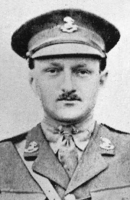
CPL David Wallace Crawford
1887 - 1916
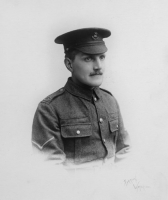
Lce-Corpl John Joseph Nickle
1894 - 1916
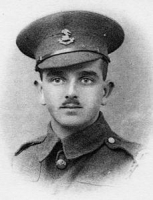
Pte 17911 Morton Neill
1897 - 1916
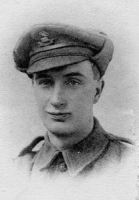
Lieut Edward Stanley Ashcroft
1883 - 1918
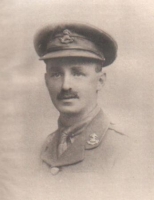
Pte 21518 Charles Esau Heath
- Age: 22
- From: Rangoon, India
- Regiment: The King's (Liverpool Regiment) 19th Btn
- K.I.A Sunday 30th July 1916
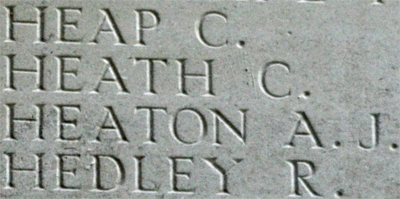
- Commemorated at: Thiepval Memorial
Panel Ref: P&F1D8B &8 C.
Charles Esau Heath was born on 14th November 1893 in Rangoon, Burma, to Walter Heath and his wife Kate (nee Mackescy). Walter, a professional soldier with the Royal Engineers, was born in Portsea Island, Hampshire, and Kate in Templebrady, Cork, Ireland. They married on the 01st September 1892 at St Bridget’s Parish Church, Crosshaven, Co.Cork. Walter Joseph, residence Chatham, a soldier in the Royal Engineers, father Esau a mason, whilst Kate was aged 20, a seamstress of Crosshaven, father John a shopkeeper. They had five children, all born abroad. Charles was the eldest; his siblings were Walter, Albert, Leonard (all born in Rangoon), and Kathleen (born in Karachi). Charles Esau was baptised on the 30th November 1893 in Rangoon, his middle name coming from his paternal grandfather.
It is not known when his father was posted to the UK, but by 1901 they are living in the village of Crosshaven, Templebrady, Cork. His father, aged 32, is a Sergeant in the Royal Engineers, his mother Kate is 31. There are four children in the household; Charles is 7, Walter 6, Albert 4, and Leonard is one year old (but appears to have died before the next census).
In 1911 the family are at “Grange House”, 21 Whipcord Lane, Chester. His father is aged 41, an army pensioner and ledger clerk, his mother Kate is 41. They have been married for 18 years and have had 5 children 4 of whom have survived. There are three children in the household; Charles aged 17, is working as a warehouse clerk for a clothing and outfitter’s, his brother Albert is 14, an apprentice plumber, and Kathleen is 8 at school.
Charlie, as he was known to his Pals, enlisted at St George's Hall in Liverpool on 03rd September 1914, giving his age as 20 years and 300 days, and his occupation as a clerk. The original regimental number of 18119 is crossed out and replaced by 21518, No.4 Company, 19th (Pals) Battalion, of The King’s Liverpool Regiment. He was described as being five feet ten inches tall, weighing 122 lbs, 33" chest, with a sallow complexion, grey eyes, and brown hair. He gives his next of kin as his father Walter, at 21 Whipcord Lane, and his religion as Roman Catholic (his father was Church of England, his mother and all the children were Roman Catholic).
Charles trained locally at Sefton Park and Knowsley Hall, then at Belton Park Camp in Grantham, Lincolnshire, and for final infantry training at Larkhill Camp on Salisbury Plain. Whilst at Larkhill, on 3rd September 1915, Charles was admonished for being ‘improperly dressed on guard mounting’. Charles shipped to France with his battalion on 7th November 1915, and in the new year the Pals battalions are in the line at the Somme, near Carnoy. On 11th January Charles is in hospital, sick, and rejoins his unit on the 22nd. He is attached to the 30th division Salvage Co. from 15th February to 2nd March, when he is again admitted to hospital in Rouen with influenza. By June, after specialist training for the ‘Big Push’, the battalion is in the front line near Maricourt.
Chester Chronicle on 29th July 1916:
“Cestrians in the Big Push:
Chester young men, many of whom joined the “Liverpool Pals”, played a conspicuous part in the commencement of the “Great Push” but their doings have, with one or two exceptions, not seen the light of print. This particular Liverpool regiment rendered excellent service, for which they have been deservedly praised, and it is therefore interesting to learn that amongst the “Pals” who have earned distinction are several members of the Sealand United Football Club junior organisation which in 1914 had proved equal to the task of acting as reserve team to the Chester F.C. A few months after the war broke out, with that good sporting spirit which was characteristic of them, the whole team joined the colours and to their credit, be it said, they have proved in this serious battle of life just as trustworthy and keen as they were found to be on the field of play. One of their number – Cecil J. Wright, writing to his home, 52 Gladstone Avenue, Chester, says, ‘No doubt you will have heard by this that we have been giving the Huns a very nasty smack. We captured four lines of their trenches, which means an advance of about a mile and a quarter and could have gone on further had we have wished, but as this was our objective we had to remain. It was very amusing to see the Germans come out of their trenches with their hands stretched above their heads shouting “Kamerade”. They were a very poor-looking lot – Bavarians, half-starved and proper pale looking. Our casualties were very slight considering the ground we gained and as regards the enemy’s losses they were terrific. They appeared to have no reserves, and nobody entrenched in front of us. We are now having a rest well behind the lines, having done our share of the dirty work. Charles Heath and G. Pinches are all right. The Germans are absolutely beaten on this part of the front. The way they gave themselves up was a disgrace to the German army. I have got many souvenirs such as German helmets, or, as a matter of fact, anything, but as we are not allowed to bring these articles home I let them slide.’
Writing on subsequent dates, Private Wright says, ‘the battalion is still resting behind the lines after their grand work and were enjoying the peaceful surroundings. Heath and Pinches are all right.’
Wright, before joining the “Liverpool Pals”, was in the office of Messrs. Potts, Potts and Gardner, solicitors, Chester.”
As his Pal Cecil Wright wrote, Charlie survives the deadly days of July 1916 at the Somme, until on the 30th, when three Pals battalions are tasked with taking the village of Guillemont. The attack fails and with nearly 500 killed, this is the blackest day of the war for the City of Liverpool.
Graham Maddocks, in his book “Liverpool Pals” (p.123-4), gives details of the events:-
No.3 and No.4 Companies, intermingled because of the fog, soon came across a small German strongpoint on their line of advance, just to the south of Arrowhead Copse, and after a fierce hand-to-hand encounter, they captured it. Two friends from Chester wrote home separately to describe their experiences.
“We were in reserve for a week just behind the line waiting for our third attack. On the night of 29th July we moved up to our position just ahead and on the right of Trones Wood. Here we took up our position in shell holes just behind the 19th, and dug ourselves in for safety, awaiting early morning when the advance was due to take place at 4.45. We were in our stations, myself being with Ossy Eyes [Pte 15985 J.O. Eyes]. Frank [16016 F.A. Pierce] and his mates were quite near, also Sam’s [15938 S.H. Thomas] gun team. We were under constant fire, but not heavy, being mostly gas shells. It would be towards one or two o’clock when poor old Sam met his fate. Our sergeant had just given us our rum ration and gone to the shell hole where the gun team were, and here, unfortunately, one gas shell found its mark, landing in the centre of the gunners. Poor lads, it wiped the whole of them out.
It was a bad start for us, but at 4.45 the boys were up – into the mist they went headed by our section commanders. We ploughed along taking shelter here and there, for they poured one continual rain of lead at us. We were suffering terrible losses but the boys kept on. When we first started the attack, I saw Frank leading his section on. He was on our right, but he disappeared into the mist. We kept pushing forward and were then held up by a German advance trench (a strong point). Here we fought for three-quarters of an hour, when the enemy saw their chance was hopeless they downed arms, hands up, and cried like children for mercy.
We took up our position in what was once the German trench – only three of us out of our section, our NCO, Ossy, and myself. Getting lost, we attached ourselves to the 19th. Here we met another of our Pals who had also got lost. He was one of Frank’s section. Then he told us the terrible news. Frank was leading his section in the charge, and unfortunately was shot through the heart. The sights were bad enough, but the shock of losing Frank and Sam as well! I can’t describe my feelings – it’s heart-breaking. They were two fine fellows, so very popular in the company, and not only were they excellent soldiers, but thorough gentlemen too!” - 15971 Lance Corporal H. Foster (who survived the war).
“Ossy Eyes [15985, J.O. Eyes] and I who managed to come out of this without a scratch are badly cutup over this terrible affair, and I know you, and all those who know those dear comrades of ours will be badly upset about it. Poor old Charlie [21518 C. Heath] met his death while performing a very brave act. Our battalion were in the first wave that went over, and when we advanced so far, we got orders to get down, and Charlie, who noticed a German machine-gun a few yards ahead of him, charged with one or two others to try and capture it, but was fatally hit by a bomb. Frank Pierce [16016 F.A. Pierce] was sniped through the head and Sam Thomas [15938 S.H. Thomas] was knocked out by a gas shell while going up the trenches the night previous to the attack. Gordon Pinches [21589 N.G. Pinches] was killed with a bullet, but where it caught him exactly, I could not say.” – 21646 Private C.J. Wright (recipient of the Military Medal, himself hit and killed by an aerial bomb on 8th October 1918, just a month before the Armistice).
Charlie’s body was never recovered, or was subsequently lost, he has no known grave, and is now remembered on the Thiepval Memorial to the Missing of the Somme.
The Thiepval Memorial, the Memorial to the Missing of the Somme, bears the names of more than 72,000 officers and men of the United Kingdom and South African forces who died in the Somme sector before 20 March 1918 and have no known grave. Over 90% of those commemorated died between July and November 1916.
On 01st August 1932 the Prince of Wales and the President of France inaugurated the Thiepval Memorial in Picardy. The inscription reads: “Here are recorded the names of officers and men of the British Armies who fell on the Somme battlefields between July 1915 and March 1918 but to whom the fortune of war denied the known and honoured burial given to their comrades in death.”
19th Battalion Diary 30th July 1916
MALTZ HORN FARM
BATTLE begun. ZERO hour 4:45 am. The Battalion reached its objective, but suffered heavy losses, and had to evacuate its position owing to no reinforcements.
Everard Wyrall gives details of the attack in his book The History of The King’s Regiment;
"The 2nd Attack on Guillemont- 29th July 1916 the 89th Brigade the 20th King's were to attack on the right and the 19th on the left. During the evening of the 29th the night was dark and foggy when the Battalions moved off and the 19th with Lt Col G Rollo commanding, when passing the South east of the Briqueterie they were heavily shelled first with H E and then with a new kind of asphyxiating Gas shell which had curious results, at first it had no nasty effect but about 8 hrs later men began to fall sick with violent headaches and pains in the stomach. All ranks had to wear gas masks which in the darkness and mist made the going terribly difficult. It was indeed wonderful that they were able to reach their Assembly point at all. But they did and by 2.45 a.m. on the 30th July 1916 the Btn was assembled having suffered about 30 Casualties on the way up ready for the Zero hour at 4.45 a.m.
It is known that the two left Companies of the 19th under Capt. Dodd and Capt. Nicholson advanced in touch with the 2nd Royal Scots Fusiliers on their left although they suffered many casualties from Machine gun Fire did not encounter many Germans and reached their final objective about the time allocated, beginning at once to dig in south of the orchard on the South east corner of Guillemont.
On the left of the 19th the Scots Fusiliers most gallantly forced their way through Guillemont to the eastern side of the village but were soon overwhelmed by the enemy and few returned.
At 8 a.m. finding that the village was not held the two left Companies of the 19th received no word from the rear or either flank believed themselves to be totally isolated so were forced to fall back and dig in, their position being untenable.
At midday the effective fighting strength of the 19th Btn was just 7 Officers and 43 other ranks"
When darkness fell on the battlefield the 30th Division held a line from the railway on the eastern side of Trones Wood , southwards and including Arrow Head Copse, to east of Maltz Horn Farm. On this line the division was relieved by the 55th Division during the early hours of the 31st July.
Casualties in the 19th Battalion were 11 Officers and 435 Other Ranks
The events of 30th July 1916 were regarded at the time as Liverpool’s blackest day. There follows an extract from The History of the 89th Brigade written by Brigadier General Ferdinand Stanley which gives an indication of the events of the day.
Guillemont
Well the hour to advance came, and of all bad luck in the world it was a thick fog; so thick that you couldn’t see more than about ten yards. It was next to impossible to delay the attack – it was much too big an operation- so forward they had to go. It will give some idea when I say that on one flank we had to go 1,750 yards over big rolling country. Everyone knows what it is like to cross enclosed country which you know really well in a fog and how easy it is to lose your way. Therefore, imagine these rolling hills, with no landmarks and absolutely unknown to anyone. Is it surprising that people lost their way and lost touch with those next to them? As a matter of fact, it was wonderful the way in which many men found their way right to the place we wanted to get to. But as a connected attack it was impossible.
The fog was intense it was practically impossible to keep direction and parties got split up. Owing to the heavy shelling all the Bosches had left their main trenches and were lying out in the open with snipers and machine guns in shell holes, so of course our fellows were the most easy prey.
It is so awfully sad now going about and finding so many splendid fellows gone.
In the Liverpool Echo on 30th July 1917, under the heading ‘Lost At The Battle of Guillemont’ –
“July 30, 1916. In grateful and loving memory of Privates W.J. Wrigley (Willie) H.J. Voce, and Charles Heath (Pals) killed at battle of Guillemont, Somme. (Never forgotten by Willie’s dad. R.I.P.)”
Also in the Liverpool Echo, on 30th July 1917 under the heading ‘Lost At The Battle of Guillemont’ firends paid tribute to their fallen "chums":
Pierce, Heath, Pinches, and Thomas – To the memory of Frank Pierce, Charles Heath, Gordon Pinches, and Sam Thomas, K.L.R. (Pals), killed in action on Sunday, July 30, 1916, at Guillemont. (Ever dear to all their Chums.)”
His next of kin were notified in August 1917 that there were no personal effects to be sent. Charlie earned his three medals; his effects went to his father Walter. His parents received his War Gratuity and pension.
Charles is remembered on the Chester Town Hall Memorial.
In May 1919 his father supplied information concerning living relatives: His parents and sister Kathleen were still living at 21 Whipcord Lane, Chester; his brother Walter, 24, was with the Royal Engineers Signals, in Bedford.
Charles’ brother Albert, Pte 1574 “B” Coy, 5th Bn Cheshire Regiment, died of wounds barely six weeks later, on 13th September 1916, aged 20. He now lies in Corbie Communal Cemetery, Somme, where his gravestone inscription reads,
“ALSO IN MEMORY OF PRIVATE CHARLES HEATH KILLED ON THE SOMME, R.I.P.”
Both brothers were featured in the Chester Chronicle on Saturday 27 December 1919:
THE GLORIOUS DEAD.
CHESTER ROLL OF HONOUR.
HEATH (1574) Albert, 5th Cheshire Regiment.
HEATH (21518) C.E., 19th King’s Liverpool Regiment.
His mother Kate died on the 09th June 1930, aged 60, and his father Walter on the 03rd October 1960, aged 91. They are buried in Overleigh Cemetery, Chester.
His mother's death was reported in the Cheshire Observer on Saturday 14 June 1930:
HEATH—On 9th June, 1930, at Chester Nursing Home, Kate, beloved wife of Walter Heath, and darling mother of Kathleen and Walley.—"At rest." - 21, Whipcord Lane, Chester.
His father's death was reported in the Cheshire Observer on Saturday 08 October 1960:
HEATH—On 3rd October, 1960. In his 92nd year, Walter, dearly loved husband of the late Kate Heath and father of Kathleen and Walter, at 40 Park-drive.
We currently have no further information on Charles Heath. If you have or know someone who may be able to add to the history of this soldier, please contact us.
89th Brigade On This Day.
110 Years Ago.The Battle of the Transloy Ridges begins. more....
Killed On This Day.
(110 Years this day)Monday 16th October 1916.
Pte 22929 Edward Bird
19 years old
(110 Years this day)
Monday 16th October 1916.
Pte 16795 William Frederick Collister
23 years old
(109 Years this day)
Tuesday 16th October 1917.
L/Cpl 49038 Ernest Yardley
31 years old
(108 Years this day)
Wednesday 16th October 1918.
Pte 85187 James Hoy
31 years old
(107 Years this day)
Thursday 16th October 1919.
Pte 36438 Hugh Morris
23 years old